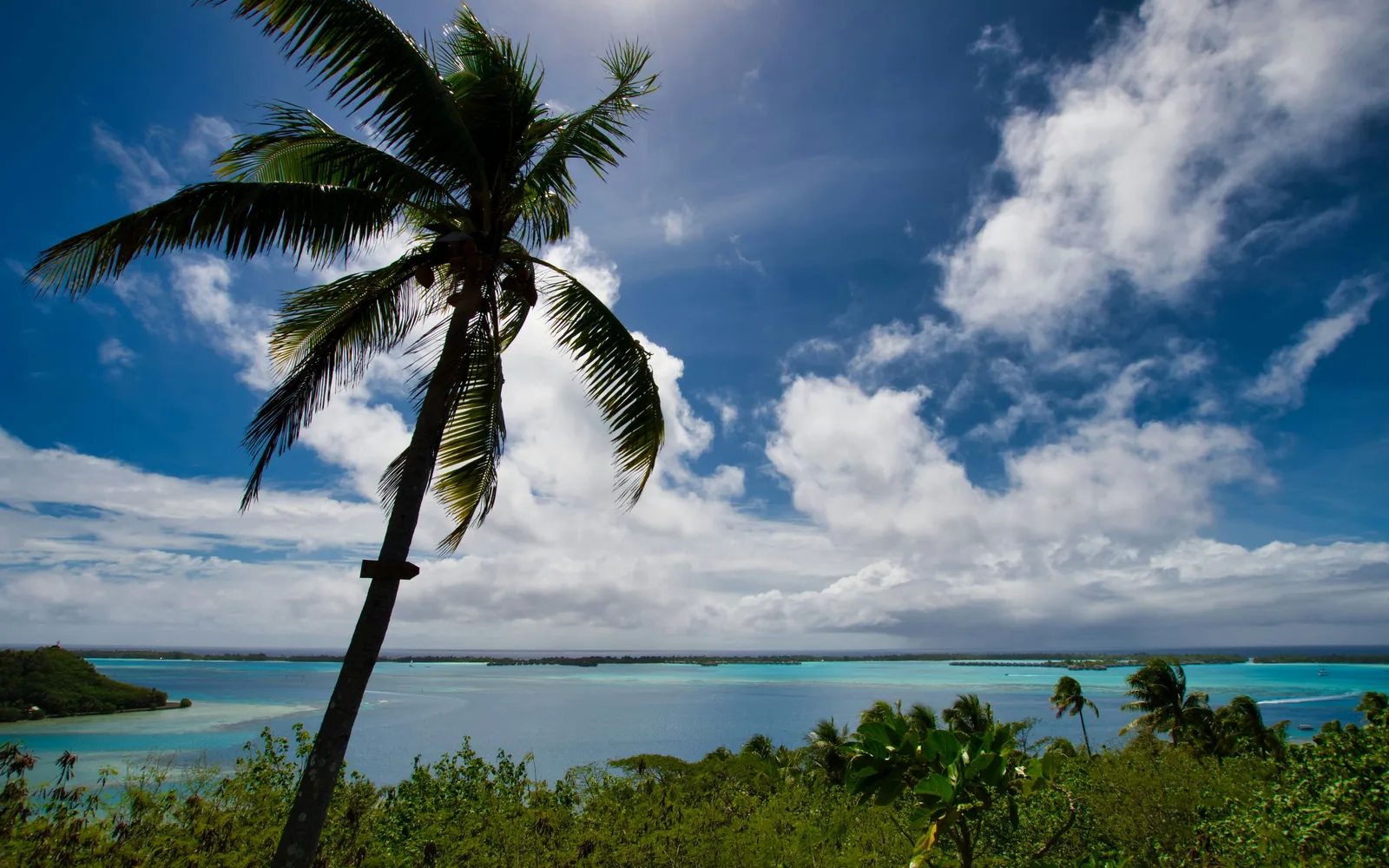
121 islands and one tariff
French Polynesia is an overseas collectivity of France, 121 islands scattered across more than 2,000 kilometres of the South Pacific, organised into five archipelagos: the Society Islands (Tahiti, Mo'orea, Bora Bora, Huahine), the Tuamotus (Rangiroa, Fakarava, Tikehau), the Marquesas, the Australs, and the Gambiers. Most travelers fly into Faa'a on Tahiti and continue on Air Tahiti to one or two further islands. Connectivity has to follow the inter-island flights, the boat days, and the bungalow week — without you swapping SIMs at every airport.
Roamzy charges $13.82 per gigabyte in French Polynesia. That's $0.0135 per megabyte, billed in real time on local networks. No subscription, no expiry, no minimum bundle. One per-MB rate across 193 countries is the entire cost breakdown, not a marketing line.
How much will Roamzy actually cost on this trip?
A typical visitor uses 0.4–0.8 GB per day: maps from Faa'a to Papeete, the Air Tahiti app for inter-island schedules, video calls home over a 12-hour gap, the camera-translator on a Tahitian sign at a fruit market in Pirae, the dive-shop's WhatsApp for tomorrow's boat. Resort and pension Wi-Fi handles a lot, so cellular is mostly for the boat days and the road. Call it 0.5 GB/day:
| Trip length | Roamzy ($13.82/GB) | Tourist roaming pass | Local SIM at PPT |
|---|---|---|---|
| 3 days (1.5 GB) | $20.74 | $25–60 | $15–30 + passport |
| 1 week (3.5 GB) | $48.38 | $50–120 | $20–40 + 30-day cap |
| 2 weeks (7 GB) | $96.77 | $100–250 (often two passes) | $30–50 + cap |
Competitor prices in columns 3 and 4 are 2025 ranges based on typical offerings; exact figures depend on your home carrier and the airport store you visit. Roamzy's rate in column 2 is our actual published rate from the pricing page.
A SIM at Faa'a is sold but the kiosk closes early, the form wants a passport and a French address line, and after a 16-hour flight from Paris or LA the patience for that isn't available. The eSIM is on the network when your phone catches the Tahitian tower from the gate.
Connectivity across the archipelagos
French Polynesia's networks cluster on the inhabited islands and thin fast on the empty atolls. Inter-island flights are silent at altitude; the eSIM picks up the local network on landing without any switching on your part.
You'll notice the gaps on long boat days. The lagoon-to-lagoon transfers in the Tuamotus and the Society Islands' inter-atoll boats often have hours with no signal — that's open ocean, the towers don't reach.
How is coverage distributed by region?
| Region | 5G | LTE | Notes |
|---|---|---|---|
| Tahiti (Papeete, Faa'a, Punaauia) | Yes | 95%+ | The densest network in the country |
| Mo'orea | Partial | Solid | Coverage around the bays, weaker on the inland trails |
| Bora Bora, Huahine, Raiatea | Partial | Solid | Resort islands well covered, atoll motus thinner |
| Tuamotus (Rangiroa, Fakarava, Tikehau) | No | Patchy 4G | Coverage near the village, gaps on the atoll rim and dive boats |
| Marquesas (Nuku Hiva, Hiva Oa) | No | 4G in town | Volcanic interior is mostly silent |
| Inter-island flights and ferries | — | — | Silent in the air, signal at the dock |
Resort and pension Wi-Fi varies. The high-end overwater bungalows on Bora Bora deliver fine throughput; smaller pensions on a Tuamotu motu deliver one router and a prayer. The eSIM is the backup that doesn't depend on the property.
Things you'll feel about French Polynesia specifically
A few practicalities worth surfacing before they surprise you:
- The Pacific Franc (XPF) is pegged to the euro. Cards are widely accepted on the Society Islands; outer atolls run cash-only at the snack shacks. Apple Pay and Google Pay work where contactless is taken.
- Air Tahiti's app is the central tool for the trip — schedules slip, weather diversions are normal in the wet season. A working data connection is what keeps the schedule readable.
- French is the working language, with Tahitian alongside. Camera-translator earns its keep at small markets and pension dinners.
- Diving days are silent — Fakarava's south pass, Rangiroa's Tiputa pass — the dive boat anchors at a place no tower reaches. Plan messages around the surface intervals.
How do I install my Roamzy eSIM?
| Plug type | Voltage | Frequency | iOS | Android |
|---|---|---|---|---|
| Type A, B, E | 220 V | 60 Hz | iPhone XS+ | Pixel 3+, Galaxy S20+ |
- Sign in to Roamzy via Telegram or Google
- Your first eSIM is free and comes with real data on us. After that, top up from $20 in stablecoins (USDT or USDC): no cards, no banks, no FX surcharges
- The QR code appears in your dashboard as soon as the eSIM is issued
- On the iPhone itself (iOS 17.4 or newer), tap Tap to install in the QR card; otherwise Settings → Cellular → Add eSIM → scan QR (do this on home Wi-Fi before you fly)
- The counter starts the moment you land at Faa'a
Supported stablecoins, networks, and common iPhone/Android setup errors are in the FAQ.
Why the tariff is built this way
A trip to French Polynesia is logistically dense — long flights, inter-island connections, a dive operator coordinating boats. Connectivity should be the one thing that doesn't compound the load.
Roamzy is built around that. No first-purchase promo to lure you, then jacked rates on the second top-up. No fine-print throttling. No auto-renewal you forgot to cancel and discover three months after the trip. One rate, billed by the megabyte, balance carries.
The French Polynesia rate sits on the high side, and we let it sit there in plain sight, metered per megabyte with no deadline attached. Honest metering isn't a positioning exercise; it was the least complicated thing to build.
What if my trip continues to other countries?
French Polynesia connects to the wider Pacific:
- New Zealand — common return-leg via Auckland, separate country rate
- Fiji — frequent Pacific crossing, the eSIM hands over at landing
- If you want the underlying mechanics — how roaming actually gets priced and why it hurts