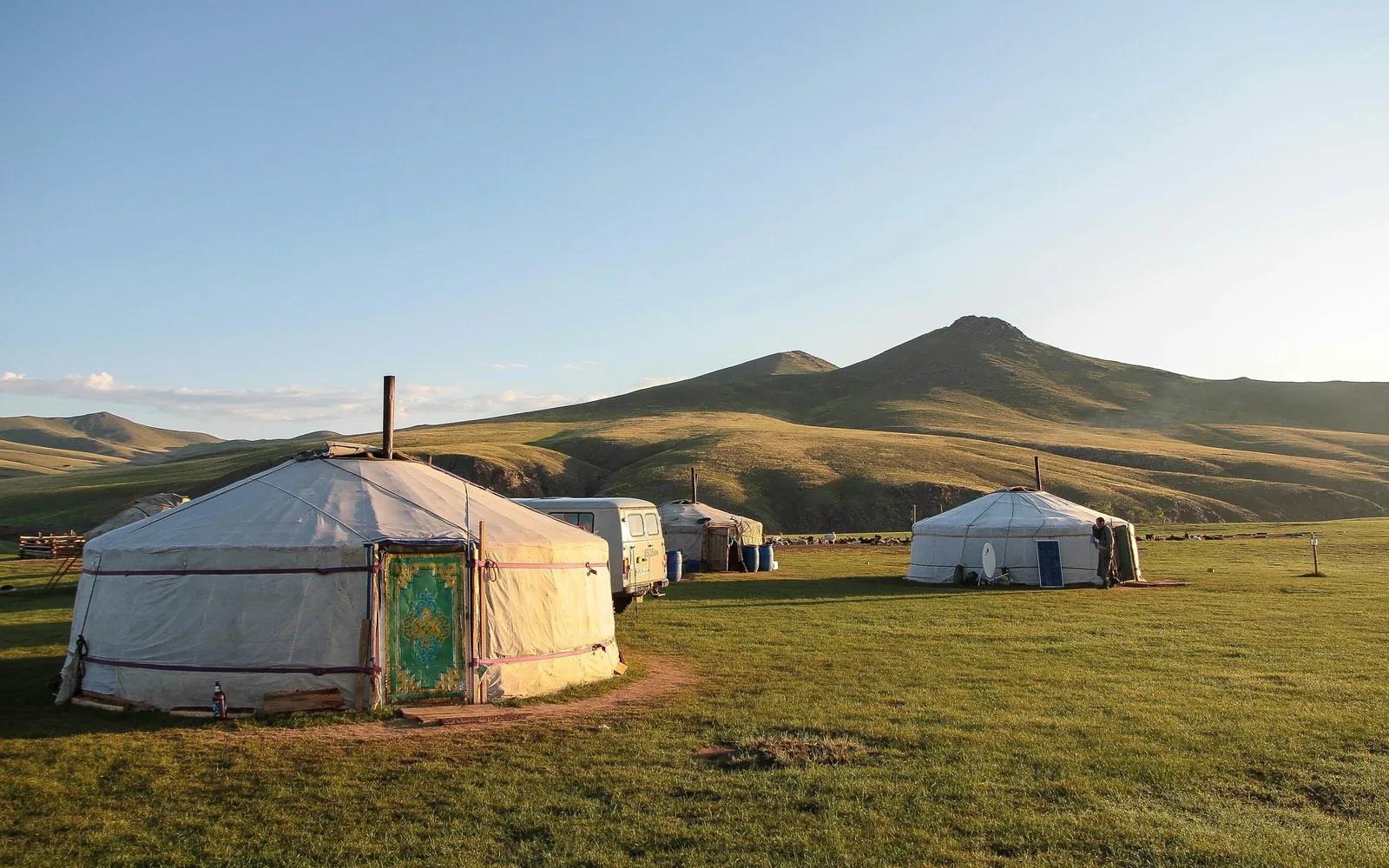
Where will you actually have signal in Mongolia?
That's the question worth asking before you book the steppe trip. The honest answer is: in Ulaanbaatar, yes; on the main paved roads, mostly; in the Gobi and on the steppe between cities, not always. Mongolia is the second-largest landlocked country in the world and one of the most sparsely populated — about 3.5 million people across more than 1.5 million km², half of them in the capital. The cell network covers UB densely and the trunk roads to a degree. Between them is genuine empty country where signal can drop for an hour or more at a stretch. No eSIM cures that. No tariff cures that.
Anyone who promises seamless 4G from the Russian border to the Gobi is selling you something. We're not.
How is Roamzy's price calculated?
Roamzy charges $4.51 per gigabyte in Mongolia. That's $0.0044 per megabyte, billed in real time on Mongolian networks. No subscription, no expiry, no minimum bundle. One per-MB rate across 193 countries is what the terms actually say, not a marketing line.
A typical visitor uses 0.5–1 GB per day: Maps in Ulaanbaatar, the camera-translator on a Cyrillic Mongolian menu, ride-hail and messaging, the occasional video call. Call it 1 GB/day:
| Trip length | Roamzy ($4.51/GB) | Tourist roaming pass | Local SIM at the airport |
|---|---|---|---|
| 3 days | $13.52 | $25–55 | $8–20 + paperwork |
| 1 week | $31.54 | $50–100 | $15–30 + paperwork |
| 2 weeks (steppe trip) | $63.08 | $100–200 (often two passes) | $25–45 + 30-day cap |
Competitor prices in columns 3 and 4 are 2025 ranges based on typical offerings; exact figures depend on your home carrier and the airport store you visit. Roamzy's rate in column 2 is our actual published rate from the pricing page.
A local Mongolian SIM at Ulaanbaatar's Chinggis Khaan airport is cheap if you're staying long. Trade-off is paperwork at the kiosk. eSIM skips that — pre-installed at home, attached on descent.
Where is Roamzy reliable, and where isn't it?
- Ulaanbaatar — strong LTE end to end, 5G in the central districts
- Erdenet, Darkhan, Choibalsan — solid LTE in the urban cores
- The paved trunk roads (UB to Kharkhorin, UB to Mörön) — mostly LTE, gaps in the long inter-village stretches
- Steppe gers and nomad camps — 3G or worse, sometimes voice only, often nothing
- The Gobi (Yolyn Am, Khongoryn Els, Bayanzag) — assume nothing; signal at a handful of tourist-camp clusters and nowhere else
- The northern lakes (Khövsgöl) — LTE in Mörön, weakening fast on the road north
- The Altai mountains (Ölgii, Khovd) — 4G in the towns, nothing in the high country
If you're driving across the steppe or trekking the Gobi, an offline-cached map (Maps.me, Organic Maps) and a satellite messenger like Garmin inReach are baseline kit, not luxury.
How do I install my Roamzy eSIM?
| Plug type | Voltage | Frequency | iOS | Android |
|---|---|---|---|---|
| Type C, E | 220 V | 50 Hz | iPhone XS+ | Pixel 3+, Galaxy S20+ |
- Sign in to Roamzy via Telegram or Google
- Your first eSIM is free and comes with real data on us. After that, top up from $20 in stablecoins (USDT or USDC): no cards, no banks, no FX surcharges
- The QR code appears in your dashboard as soon as the eSIM is issued
- On the iPhone itself (iOS 17.4 or newer), tap Tap to install in the QR card; otherwise Settings → Cellular → Add eSIM → scan QR
- The counter starts the moment you land at UBN
Supported stablecoins, networks, and common iPhone/Android setup errors are in the FAQ.
What are Roamzy's honest limitations?
The most useful thing we can tell you about Mongolia is where you won't have signal. Most eSIM resellers paint the country a solid green and promise blanket coverage. That's a lie, and it'll catch you somewhere east of Mörön at midnight in a snowstorm.
We don't promise blanket coverage. We sell access to the same networks Mongolians use, and we say it plainly: cities are fast, paved trunks are mostly fine, the steppe and Gobi are luck of the draw. That's geography, not a product flaw.
- No welcome promo that bait-and-switches the second top-up. The rate on top-up #1 is the rate on top-up #20.
- No fine-print throttling. One rate, full speed — first GB and the hundredth both cost $0.0044/MB.
- No auto-renewal. Balance runs out, the eSIM stops.
The honest version of a Mongolia tariff is short: a meter, a rate, no deadline. We shipped the honest version because anything cheaper-sounding would have to smuggle the difference into the terms.
What if my route continues across the region?
The eSIM hands over the moment you cross. Mongolia connections are usually long-haul:
- Chile — common for long-haul travelers chaining mountain trips on different continents
- Peru — onward via Asian or European hubs for the Andes leg
- If you want the underlying mechanics — how roaming actually gets priced and why it hurts