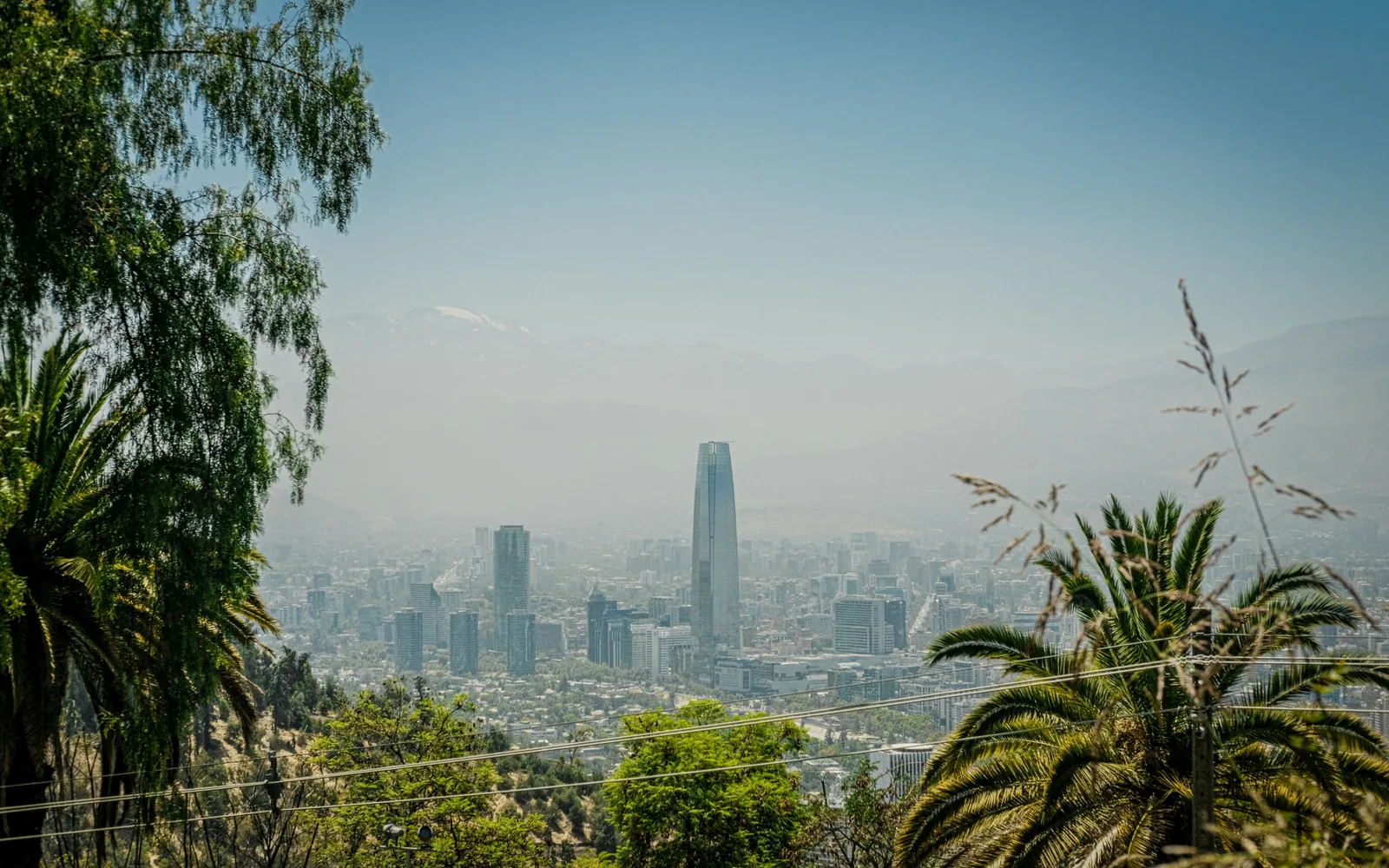
Chile is the long-country problem
Chile runs roughly 4,300 km north–south along the Pacific, from the Atacama (the driest non-polar desert in the world) down to Patagonia and Tierra del Fuego — and it's narrow enough that you can drive across it in most places in a few hours. The cell network reflects that shape: dense around Santiago and Valparaíso, solid along the coastal route, thinner in the Atacama interior, patchy in the southern fjords and glacier country.
Anyone who promises seamless 4G from Arica to Punta Arenas is selling you something. We're not.
How is Roamzy's price calculated?
Roamzy charges $4.51 per gigabyte in Chile. That's $0.0044 per megabyte, billed in real time on Chilean networks. No subscription, no expiry, no minimum bundle. One per-MB rate across 193 countries is a line on your bill, not a marketing line.
A typical visitor uses 0.5–1 GB per day: Maps in Santiago and on the Carretera Austral, the camera-translator on Spanish-only signage where English is light, ride-hail and messaging, the occasional video call. Call it 1 GB/day:
| Trip length | Roamzy ($4.51/GB) | Tourist roaming pass | Local SIM at the airport |
|---|---|---|---|
| 3 days (Santiago) | $13.52 | $25–55 | $8–20 + paperwork |
| 1 week (Atacama or Patagonia) | $31.54 | $50–110 | $15–30 + paperwork |
| 2 weeks (north + south) | $63.08 | $100–220 (often two passes) | $25–45 + 30-day cap |
Competitor prices in columns 3 and 4 are 2025 ranges based on typical offerings; exact figures depend on your home carrier and the airport store you visit. Roamzy's rate in column 2 is our actual published rate from the pricing page.
A local Chilean SIM at SCL is reasonably cheap. Trade is paperwork at the kiosk. eSIM skips that — pre-installed at home, attached on descent.
Where is Roamzy reliable, and where isn't it?
- Santiago metro area, Valparaíso, Viña del Mar — 5G in the cores, dense LTE
- The Pan-American Highway (Ruta 5) — solid LTE most of the spine, gaps in the long Atacama and southern stretches
- Atacama (San Pedro de Atacama, Calama) — LTE in town, weakening fast on the salt-flat back roads and at altitude
- Lake District (Pucón, Puerto Varas, Frutillar) — solid LTE in the towns; thinner around the volcanoes
- Patagonia (Puerto Natales, Punta Arenas) — LTE in towns, light to nothing on the Torres del Paine trails
- The Carretera Austral and the southern fjords — 4G at the larger settlements, mostly nothing in between
- Easter Island and the far Pacific outliers — limited; check expectations before you fly
If you're driving the Carretera Austral or trekking Patagonia, an offline-cached map and a satellite messenger for emergencies are baseline kit, not luxury.
How do I install my Roamzy eSIM?
| Plug type | Voltage | Frequency | iOS | Android |
|---|---|---|---|---|
| Type C, L | 220 V | 50 Hz | iPhone XS+ | Pixel 3+, Galaxy S20+ |
- Sign in to Roamzy via Telegram or Google
- Top up with a minimum of 20 USDT — stablecoins, no cards, no banks, no FX surcharges
- The QR code appears in the dashboard once payment confirms
- Settings → Cellular → Add eSIM → scan QR
- The counter starts the moment you land at SCL, CJC, or PMC
Supported stablecoins, networks, and common iPhone/Android setup errors are in the FAQ.
What are Roamzy's honest limitations?
The most useful thing we can tell you about connectivity in Chile is where it won't be. Most eSIM resellers paint the country a solid green and promise "blanket coverage." That's a lie, and it'll catch you on the Carretera Austral somewhere south of Coyhaique with no signal until tomorrow.
We don't promise blanket coverage. We sell access to the same networks Chileans use, and we say it plainly: cities are fast, the Pan-American is mostly fine, the Atacama interior and the south are luck of the draw. That's geography, not a product flaw.
- No welcome promo that bait-and-switches the second top-up. The rate on top-up #1 is the rate on top-up #20.
- No fine-print throttling. One rate, full speed — first GB and the hundredth both cost $0.0044/MB.
- No auto-renewal. Balance runs out, the eSIM stops.
Per-MB in Chile is an engineering call, not a slogan: meter the data, bill the data, stop. A price with nothing hidden inside it can't be beaten by one with better hiding places.
What if my route continues across the region?
Chile pairs naturally with its Andean neighbors. The eSIM hands over the moment you cross:
- Peru — common northern continuation by air or via Arica–Tacna
- Colombia — onward via Lima or São Paulo
- If you want the underlying mechanics — how roaming actually gets priced and why it hurts