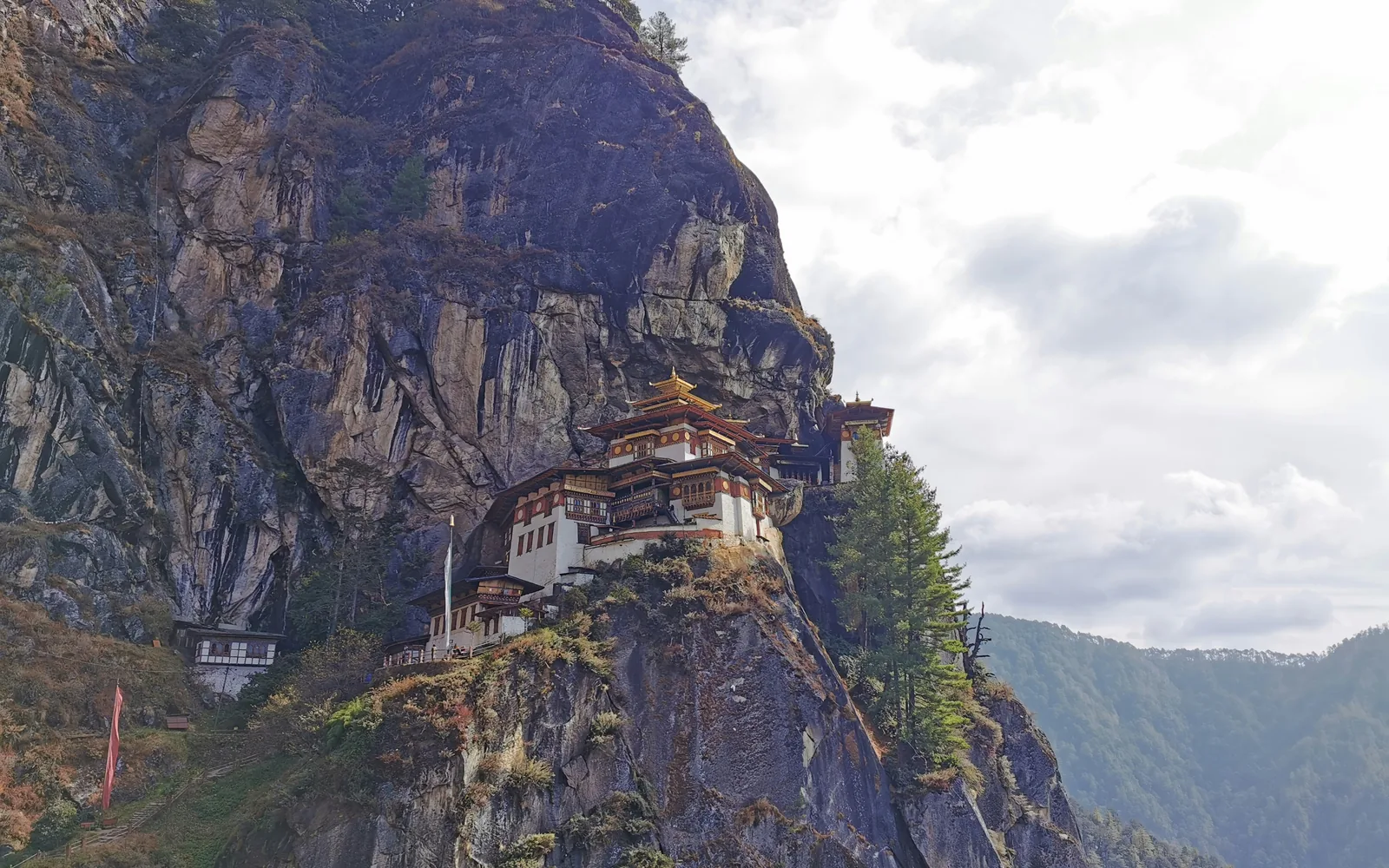
Bhutan is the country where the price actually changes the trip plan
You've already paid the Sustainable Development Fee — $100 per day for most foreign travelers. You've booked through a licensed Bhutanese tour operator because that's how the country requires you to enter. You've got an itinerary covering Paro, Thimphu, Punakha, maybe Bumthang, and the Tiger's Nest hike. You're not in Bhutan to scroll. You're there to be in Bhutan.
So when we tell you Roamzy charges $110.59 per gigabyte in Bhutan — billed at $0.1080 per megabyte in real time, and yes, that's premium-tier — we want to be clear what that means. It means cellular is for what it's actually worth on this trip: a message to your guide if you've drifted off in a market, a photo home from Punakha Dzong if Wi-Fi at the hotel is down, the camera-translator on a Dzongkha inscription. It's not for streaming, downloading, or video-calling for hours.
One per-MB rate across 193 countries applies in Bhutan too — no subscription, no expiry, no minimum bundle. It's the figure on the page, including this premium one.
Why is Roamzy priced the way it is here?
Bhutan has fewer than a million residents, mountainous terrain that's expensive to backhaul, and a national operator that doesn't run a price war for foreign-eSIM tariffs. Wholesale into the country reflects all three. Every reseller you compare will be in roughly the same band. The honest move is to plan usage around what cellular is actually for in Bhutan, not chase a discount that doesn't exist.
What it's actually for: the moment your guide is in a different shop than you, the moment you want to send your spouse a photo from the Tiger's Nest viewpoint, the moment hotel Wi-Fi is down at 22:00 and your bank app needs to confirm a $100/day SDF top-up. Plan on 0.1–0.3 GB per day, mostly. Hotel Wi-Fi handles the heavy lifting in Thimphu and Paro.
How much will Roamzy actually cost on this trip?
| Trip length | Roamzy ($110.59/GB) | Tourist roaming pass | Local SIM at Paro |
|---|---|---|---|
| 5 days, very light usage (~0.5 GB) | $55.30 | $50–110 | $10–25 + tour-operator help |
| 1 week, moderate (~1.5 GB) | $165.89 | $80–180 (often two passes) | $15–30 + paperwork |
| 10 days incl. Bumthang (~3 GB) | $331.78 | $130–250 | $20–40 + 30-day cap |
Competitor prices in columns 3 and 4 are 2025 ranges based on typical offerings; exact figures depend on your home carrier and your tour operator's arrangement. Roamzy's rate in column 2 is our actual published rate from the pricing page.
This is the table where we'd say honestly: for moderate usage on a Bhutan trip, a local SIM arranged through your tour operator usually comes out cheapest. The eSIM is the right call when you're using cellular sparingly — a half-gigabyte over the trip — and you don't want to spend the day-one half-hour at a SIM counter or hand over your passport in Thimphu. Both paths exist; pick the one that matches how you actually use a phone in a country with a mandatory guide.
Why the tariff is built this way
Bhutan's tour-guide policy is intentional. Foreign travelers move with a Bhutanese guide for almost all itineraries, the guide handles logistics, and the SDF funds infrastructure and conservation. That's the ground reality, and it changes the connectivity equation: your guide carries the relationship with the hotel, the driver, the monastery permit, the restaurant. You don't have to translate. You don't have to navigate. The phone falls back into being a camera and a messaging device.
One thing the policy doesn't change is the value of having data when you want it. Walking the Tiger's Nest path, separated from the group for ten minutes, wanting to confirm whether the guide is at the cafeteria or further up — that's exactly when cellular pays off. The eSIM exists for that moment.
How is coverage distributed by zone?
- Thimphu — 4G across the city, working signal in the centre
- Paro and the Tiger's Nest approach — LTE in town, weakening on the hike, gone above the cafeteria
- Punakha and the Dzong — LTE in the valley
- Phobjikha (Black-Necked Crane valley) — patchy, often no service in the wider valley
- Bumthang and the Bumthang Cultural Trek — town fine; trails dark
- Trans-Bhutan Trail (long-distance) — multi-day stretches with no signal at all; the guide carries a satellite messenger if you've booked one
How do I install my Roamzy eSIM?
| Plug type | Voltage | Frequency | iOS | Android |
|---|---|---|---|---|
| Type C, D, F, G (mixed) | 230 V | 50 Hz | iPhone XS+ | Pixel 3+, Galaxy S20+ |
- Sign in to Roamzy via Telegram or Google
- Top up the eSIM with a minimum of 20 USDT — stablecoins, no cards, no banks, no FX surcharges
- The QR code appears in the dashboard once payment confirms
- Settings → Cellular → Add eSIM → scan QR (do this on home Wi-Fi before you fly)
- The counter starts when you land at Paro (PBH)
Bhutan outlets are a mix — bring a universal adapter. Supported stablecoins, networks, and common iPhone/Android setup errors are in the FAQ.
What are Roamzy's honest limitations?
- No welcome promo that flips on top-up #2. The rate stays $0.1080/MB.
- No fine-print throttling. One rate, billed by the megabyte. The first GB and the third cost the same.
- No auto-renewal you forgot to cancel. Balance runs out, the eSIM stops. No background charge to a card you'd already moved on from.
Bhutan's rate is steep, and we print it undecorated rather than disguise it. At any price point, a tariff without hidden terms is the one you can trust with your own math.
What if my trip continues across the Himalayas?
- India — most travelers connect through Delhi or Kolkata
- Nepal — common Himalayan pairing, very different network reality
- If you want the underlying mechanics — how roaming actually gets priced and why it hurts