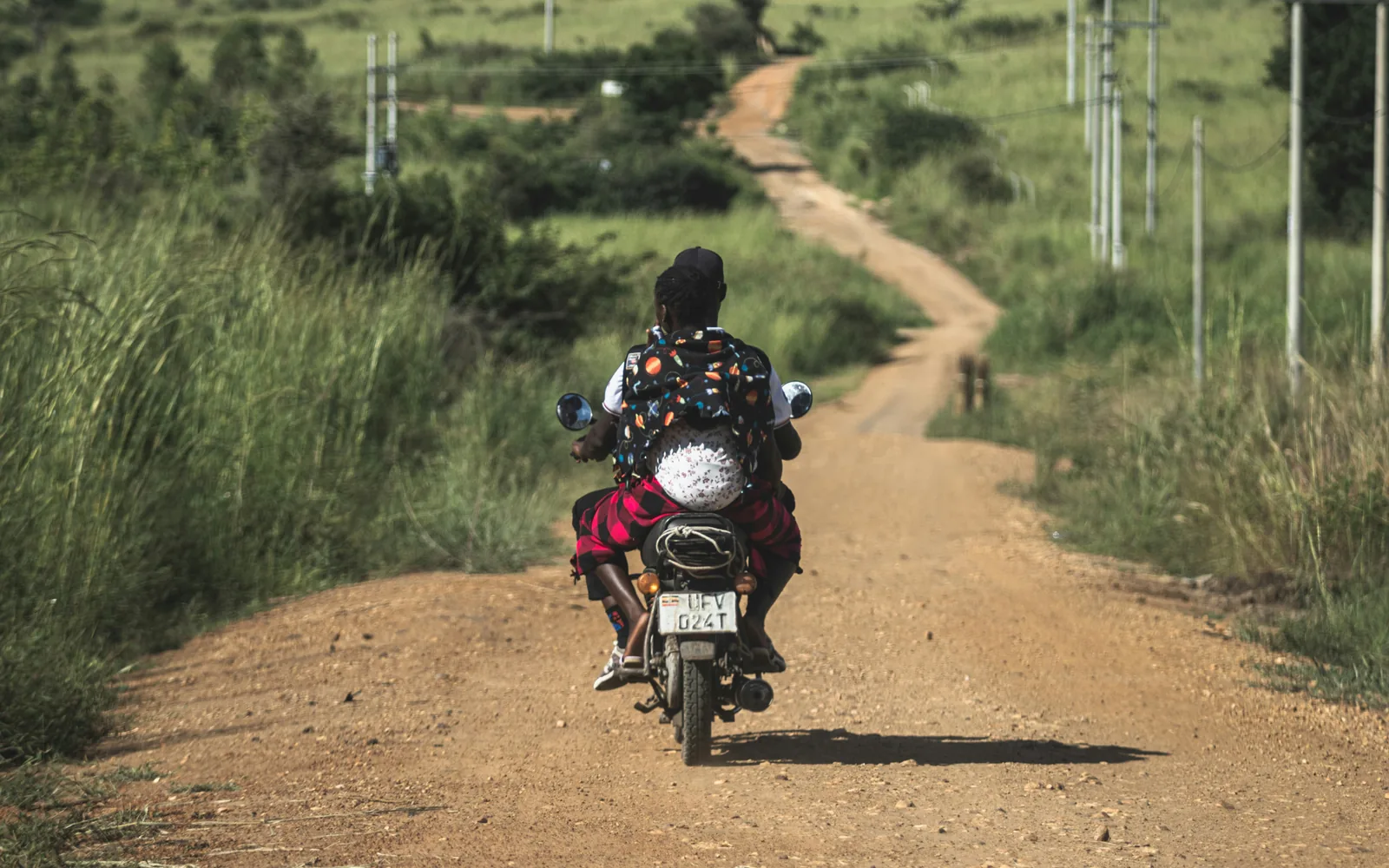
Uganda is small, dense, and has more national parks than most of East Africa
The country is roughly the size of Britain with a population pushing 50 million, most of them clustered around Lake Victoria and the central plateau. Cellular networks invest where the people are, and the result is dense LTE in Kampala and the southern corridor, workable coverage in the safari hubs (Mweya, Bwindi access roads), and the standard pattern beyond — towns yes, deep park interiors no.
Roamzy charges $4.20 per gigabyte in Uganda. That's $0.0041 per megabyte, billed in real time as your phone uses data on Ugandan networks. No subscription. No expiry on the unused balance. One per-MB rate across 193 countries is the arithmetic on your receipt, not a marketing line.
How much will Roamzy actually cost on this trip?
Uganda's classic itinerary is Kampala plus a gorilla-trekking trip in Bwindi or Mgahinga, often combined with Queen Elizabeth or Murchison Falls. Cellular usage is moderate. Plan on 0.5–0.8 GB/day:
| Trip length | Roamzy ($4.20/GB) | Tourist roaming pass | Local SIM at EBB |
|---|---|---|---|
| 5 days (Kampala + park) | $12.60 (3 GB) | $45–110 | $5–15 + paperwork |
| 10 days (multi-region) | $25.19 (6 GB) | $80–180 | $15–30 + 30-day cap |
| 2 weeks | $37.79 (9 GB) | $120–250 (often two passes) | $25–45 + 30-day cap |
Competitor prices in columns 3 and 4 are 2025 ranges based on typical offerings; exact figures depend on your home carrier and the local market reality. Roamzy's rate in column 2 is our actual published rate from the pricing page.
A local SIM at Entebbe International (EBB) is genuinely cheap and a reasonable choice for a longer self-organized trip. For a 5–7 day fly-in safari the eSIM is faster and the math is comparable.
Where is Roamzy reliable, and where isn't it?
- Kampala, Entebbe — solid 4G/LTE, 5G in central districts
- The Kampala–Jinja highway and the Lake Victoria corridor — continuous LTE
- Murchison Falls National Park — 4G near the gates and Paraa; weaker deeper in
- Queen Elizabeth National Park — 4G near Mweya and Katunguru; sparse on game drives
- Bwindi Impenetrable Forest — workable 4G near Buhoma and Ruhija lodges; trail access is signal-light
- Mt Elgon and the Sipi Falls area — 4G in towns, patchy on hikes
- The Karamoja region (Kidepo) — sparse cellular; long stretches without signal
For a gorilla trek in Bwindi, treat cellular as available at the lodge, intermittent on the trail. Lodge Wi-Fi takes the rest.
How do I install my Roamzy eSIM?
| Plug type | Voltage | Frequency | iOS | Android |
|---|---|---|---|---|
| Type G | 240 V | 50 Hz | iPhone XS+ | Pixel 3+, Galaxy S20+ |
- Sign in to Roamzy via Telegram or Google
- Your first eSIM is free and comes with real data on us. After that, top up from $20 in stablecoins (USDT or USDC): no cards, no banks, no FX surcharges
- The QR code appears in your dashboard as soon as the eSIM is issued
- On the iPhone itself (iOS 17.4 or newer), tap Tap to install in the QR card; otherwise Settings → Cellular → Add eSIM → scan QR
- The counter starts the moment you land at EBB
Supported stablecoins, networks, and common iPhone/Android setup errors are in the FAQ.
What are Roamzy's honest limitations?
Three traps Roamzy doesn't have, because they were never built in.
- No welcome promo that flips on the second top-up. Top-up #1 and top-up #20 cost the same per megabyte.
- No fine-print throttling on the day you fly to Bwindi.
- No auto-renewal you forgot to cancel after the safari. Balance runs out, the eSIM stops.
This isn't positioning; it's plumbing. A per-MB tariff in Uganda with no fine print leaves nothing for a rival deal to hide behind, or to beat.
What if my trip extends across East Africa?
- Rwanda — common pairing, often combined for gorilla trekking on both sides
- Kenya — east to Nairobi by air or via the Malaba border
- Tanzania — south for the Serengeti and Kilimanjaro
- If you want the underlying mechanics — how roaming actually gets priced and why it hurts