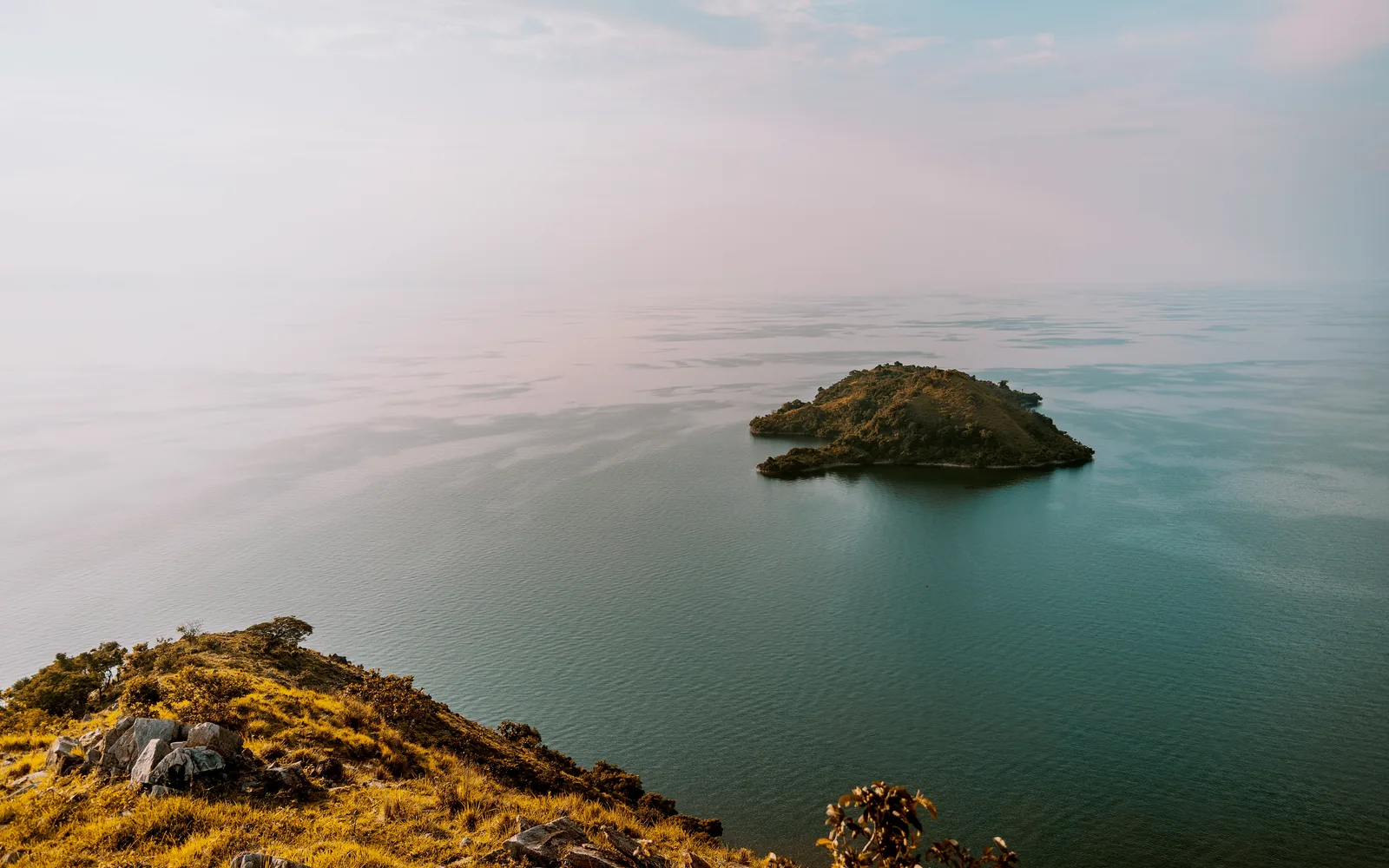
Rwanda is one of the better-covered small countries in East Africa
The country is roughly 26,000 km² with about 14 million people, and infrastructure investment over the last decade has been concentrated and visible — the airport, the conference business, fiber to the regional capitals. Cellular networks track that pattern: dense LTE in Kigali and along the main north-west corridor toward Musanze and the gorillas, workable coverage at Lake Kivu, and intermittent signal in the deep forest interiors of Nyungwe and the volcano slopes.
Roamzy charges $4.10 per gigabyte in Rwanda. That's $0.0040 per megabyte, billed in real time as your phone uses data on Rwandan networks. No subscription. No expiry on the unused balance. One per-MB rate across 193 countries is the raw cost of your megabytes, not a marketing line.
How much will Roamzy actually cost on this trip?
Most travelers do Kigali plus a gorilla trek in Volcanoes National Park, often paired with Lake Kivu and sometimes Nyungwe in the south. Cellular usage is moderate. Plan on 0.5–0.7 GB/day:
| Trip length | Roamzy ($4.10/GB) | Tourist roaming pass | Local SIM at KGL |
|---|---|---|---|
| 3 days (Kigali + trek) | $7.37 (1.8 GB) | $30–80 | $5–15 + paperwork |
| 1 week | $17.20 (4.2 GB) | $60–140 | $15–30 + 30-day cap |
| 2 weeks (multi-region) | $32.77 (8 GB) | $120–250 (often two passes) | $25–45 + 30-day cap |
Competitor prices in columns 3 and 4 are 2025 ranges based on typical offerings; exact figures depend on your home carrier and the local market reality. Roamzy's rate in column 2 is our actual published rate from the pricing page.
A local SIM at Kigali International (KGL) is workable for a longer trip. For a typical 3–5 day gorilla itinerary, the eSIM saves the queue and bills exactly what you used.
Where is Roamzy reliable, and where isn't it?
- Kigali — solid 4G/LTE across central districts (Nyarutarama, Kacyiru, downtown), 5G in select areas
- The Kigali–Musanze road — workable LTE through the switchbacks; brief drops in deeper valleys
- Volcanoes National Park — 4G near the lodges and Kinigi; trail signal weakens above 2,500 m
- Lake Kivu (Gisenyi, Kibuye, Cyangugu) — 4G in towns and along the lake road
- Nyungwe National Park — 4G near Gisakura; the deep forest is signal-light
- Akagera National Park — 4G near the gates; sparse on game drives
For a gorilla trek, expect signal at the lodge and on the access road, intermittent on the climb. Lodge Wi-Fi takes the rest.
How do I install my Roamzy eSIM?
| Plug type | Voltage | Frequency | iOS | Android |
|---|---|---|---|---|
| Type C, J | 230 V | 50 Hz | iPhone XS+ | Pixel 3+, Galaxy S20+ |
- Sign in to Roamzy via Telegram or Google
- Top up the eSIM with a minimum of 20 USDT — stablecoins, no cards, no banks, no FX surcharges
- The QR code appears in the dashboard once payment confirms
- Settings → Cellular → Add eSIM → scan QR
- The counter starts the moment you land at KGL
Supported stablecoins, networks, and common iPhone/Android setup errors are in the FAQ.
What are Roamzy's honest limitations?
Three traps Roamzy doesn't have, because they were never built in.
- No welcome promo that flips on the second top-up. Top-up #1 and top-up #20 cost the same per megabyte.
- No fine-print throttling on the day you trek.
- No auto-renewal you forgot to cancel after the trip. Balance runs out, the eSIM stops.
Data in Rwanda is metered by the megabyte and then left alone; no expiry date ever comes due. We'd call that a feature, except it's really just the absence of tricks.
What if my trip extends across East Africa?
- Uganda — common pairing for gorilla trekking on both sides of the Virunga range
- Tanzania — south by air for the Serengeti and Kilimanjaro
- Burundi — short hop south on a less-traveled route
- If you want the underlying mechanics — how roaming actually gets priced and why it hurts