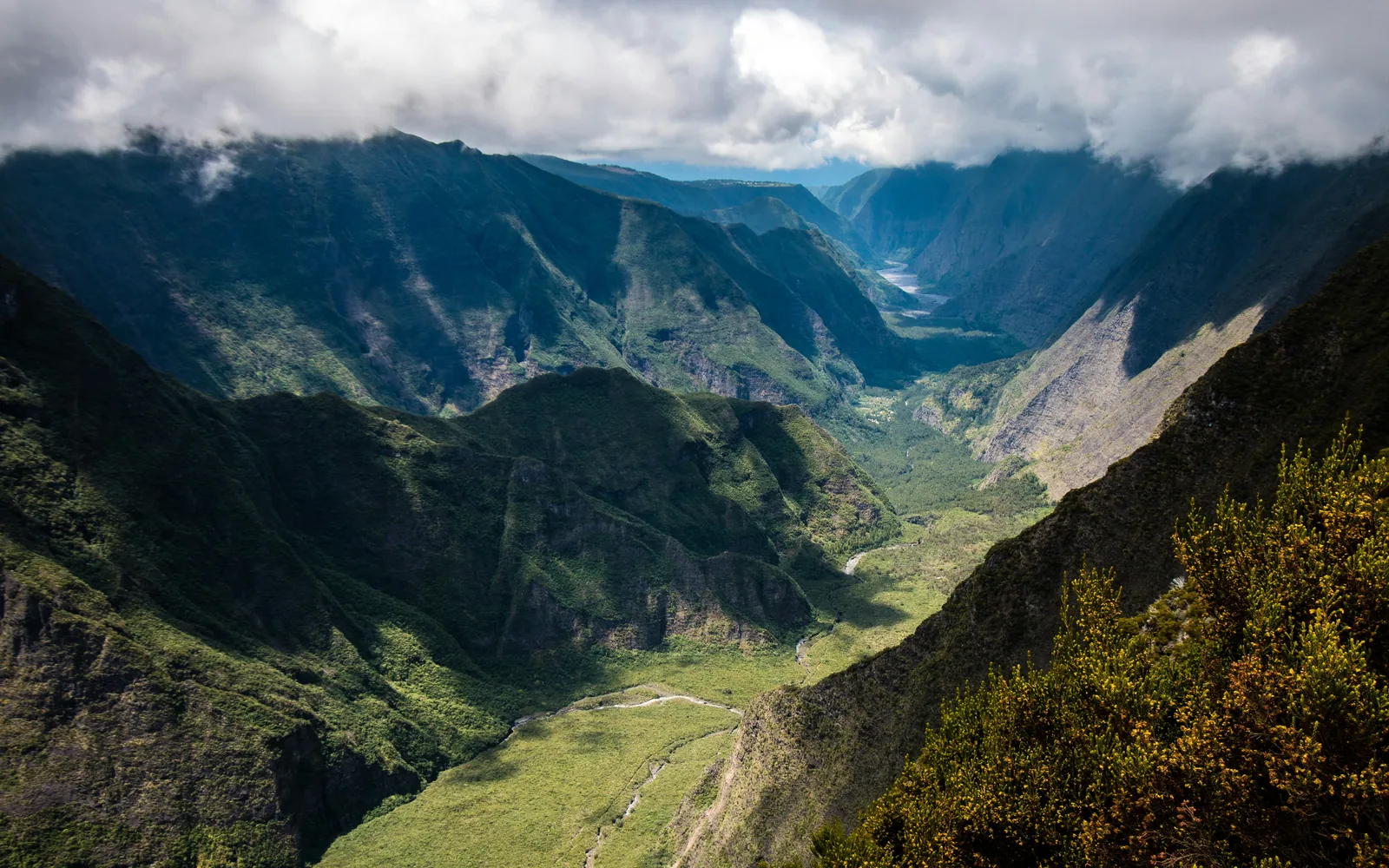
A French overseas department in the Indian Ocean
Réunion is an overseas department and region of France, 2,500 km² of volcanic island in the Indian Ocean, about 700 km east of Madagascar and 175 km southwest of Mauritius. It uses the euro, French is the working language, and EU telecom rules apply — which means the rate here is the same as in metropolitan France. The trip pattern is the volcano (Piton de la Fournaise, still active), the cirques (Mafate, Cilaos, Salazie), the lagoon at Saint-Gilles-les-Bains, and the high plain. Connectivity has to follow the road from Saint-Denis to the volcano without you swapping anything.
Roamzy charges $0.61 per gigabyte in Réunion. That's $0.0006 per megabyte, billed in real time on Réunion's networks. No subscription, no expiry, no minimum bundle. One per-MB rate across 193 countries is the whole cost story, not a marketing line.
How much will Roamzy actually cost on this trip?
A typical visitor uses 0.7–1.2 GB per day: maps from Roland-Garros to the lagoon, the trail apps for the cirques, video calls home, the camera-translator on a Creole sign at a market in Saint-Pierre, weather radar before driving up the Route du Volcan. Call it 1 GB/day:
| Trip length | Roamzy ($0.61/GB) | Tourist roaming pass | Local SIM at RUN |
|---|---|---|---|
| 3 days | $1.84 | $15–40 | $10–25 + counter visit |
| 1 week | $4.30 | $30–80 | $15–30 + 30-day cap |
| 2 weeks | $8.60 | $70–140 (often two passes) | $20–40 + cap |
Competitor prices in columns 3 and 4 are 2025 ranges based on typical offerings; exact figures depend on your home carrier and the airport store you visit. Roamzy's rate in column 2 is our actual published rate from the pricing page.
Réunion's rate sits inside the EU regulated bracket because the island is part of metropolitan France for telecom purposes. That's a structural advantage for the visitor, and we pass it through.
Connectivity across the island
Réunion is one of the better-wired Indian Ocean destinations. The coastal ring — Saint-Denis, Saint-Pierre, Saint-Gilles, Saint-Benoît — runs continuous LTE with 5G in the population centres. The interior is a different physics problem: the cirques are deep volcanic amphitheatres surrounded by 2,500-metre walls, and the line-of-sight to the coastal towers is blocked. You'll have signal in Cilaos town (it has its own tower); you'll have nothing on the trail to the Piton des Neiges summit until you crest a ridge.
How is coverage distributed by region?
| Region | 5G | LTE | Notes |
|---|---|---|---|
| Saint-Denis, the north coast | Yes | 95%+ | The densest network, the airport |
| Saint-Gilles, the lagoon | Yes | Solid | Resort and beach zone, fully covered |
| Saint-Pierre, the south coast | Partial | Solid | Working in town, weaker on the wild south |
| Cirque de Mafate | No | Patchy | Only accessible by foot or helicopter; coverage near the gîtes, gaps elsewhere |
| Piton de la Fournaise approach | No | Patchy 4G | Signal in Plaine-des-Cafres, drops on the Route du Volcan |
| Saint-Benoît, east coast | Partial | Solid | Coverage in town, weaker on the cyclone-prone roads |
Things you'll feel about Réunion specifically
A few practicalities worth surfacing before they surprise you:
- It's France. Cards work everywhere, the postal service is La Poste, and the euro is the currency. Apple Pay and Google Pay work where contactless is taken — which is most places.
- The volcano is genuinely active. Piton de la Fournaise erupts every couple of years; if it does during your trip, the road to the crater closes. The local préfecture's alerts and the volcano observatory's site are what you'll be checking.
- Cyclone season runs roughly December to April. The east coast roads can close on short notice. The eSIM running means you get the alerts the same time the locals do.
- The Mafate cirque has no road. You hike in or take a helicopter. Signal in there is sparse; offline maps and the gîte's printed booking are what you carry.
How do I install my Roamzy eSIM?
| Plug type | Voltage | Frequency | iOS | Android |
|---|---|---|---|---|
| Type C, E | 230 V | 50 Hz | iPhone XS+ | Pixel 3+, Galaxy S20+ |
- Sign in to Roamzy via Telegram or Google
- Your first eSIM is free and comes with real data on us. After that, top up from $20 in stablecoins (USDT or USDC): no cards, no banks, no FX surcharges
- The QR code appears in your dashboard as soon as the eSIM is issued
- On the iPhone itself (iOS 17.4 or newer), tap Tap to install in the QR card; otherwise Settings → Cellular → Add eSIM → scan QR (do this on home Wi-Fi before you fly)
- The counter starts the moment you land at RUN (Roland-Garros) or Pierrefonds
Supported stablecoins, networks, and common iPhone/Android setup errors are in the FAQ.
Why the tariff is built this way
A trip to Réunion is the cirques, the volcano, and the lagoon — and on a hiking-heavy itinerary you'll spend a fair portion of the trip out of signal anyway. Connectivity should be the one thing that doesn't compound the load when you're back in town.
Roamzy is built around that. No first-purchase promo to lure you, then jacked rates on the second top-up. No fine-print throttling. No auto-renewal you forgot to cancel three months after the trip. One rate, billed by the megabyte, balance carries.
Réunion rides the same cheap EU-regulated rate, and the rest of the tariff is empty on purpose: no expiry, no renewals, no clauses. Empty is very hard to discount.
What if my trip continues to other countries?
Réunion is part of a wider Indian Ocean route for many travelers:
- Mauritius — short flight east, separate country rate
- Madagascar — 700 km west, the eSIM hands over at landing
- If you want the underlying mechanics — how roaming actually gets priced and why it hurts