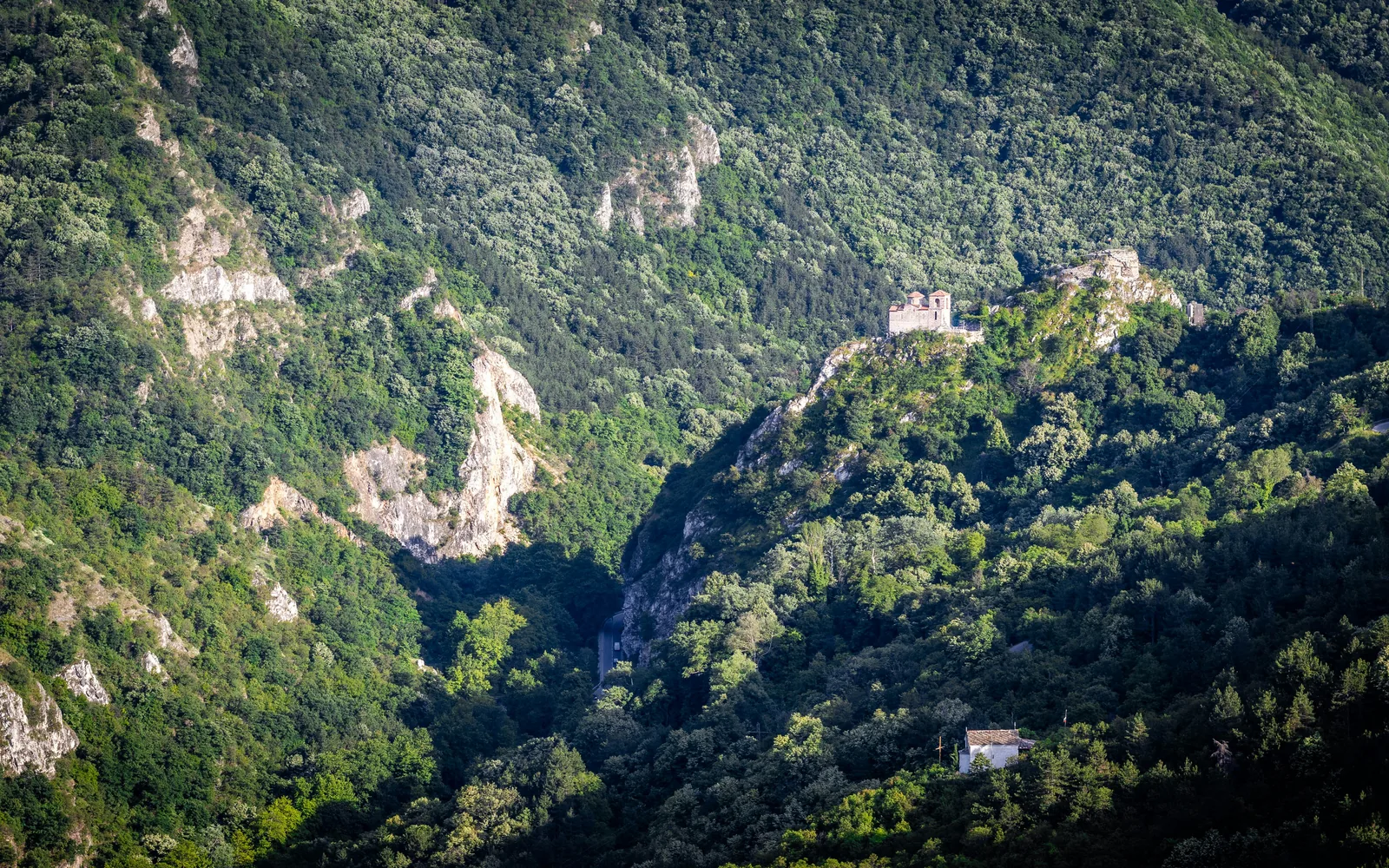
Bulgaria isn't one trip; it's three
Bulgaria splits cleanly. The Sofia–Plovdiv–Veliko Tarnovo line is the cultural axis — capital, second city, medieval fortress. The Black Sea coast (Burgas, Sunny Beach, Sozopol) is the summer-resort country, packed in July and August. The Rila and Pirin mountains are the third country: Rila Monastery, Bansko ski runs, the Seven Lakes hike. None of these run a different cell network — they run the same Bulgarian one. What differs is the geography under the signal.
Roamzy charges $0.61 per gigabyte in Bulgaria. That's $0.0006 per megabyte, billed in real time on Bulgarian networks. No subscription, no expiry, no minimum bundle. One per-MB rate across 193 countries — same rate in Sofia as on the road south to the Greek border.
How much will Roamzy actually cost on this trip?
A Bulgarian travel day uses around 1 GB: Maps for Sofia's tram-and-metro grid, the BDŽ rail app for trains, your bank app for card payments (cards work in cities, less reliably in mountain villages), the camera-translator on Cyrillic signage, video calls home. Call it 1 GB/day:
| Trip length | Roamzy ($0.61/GB) | Tourist roaming pass | Airport local SIM |
|---|---|---|---|
| 3 days | $1.84 | $15–35 | $8–20 + paperwork |
| 1 week | $4.30 | $25–55 | $12–25 + paperwork |
| 2 weeks | $8.60 | $35–90 (often two passes) | $18–35 + 30-day cap |
Competitor prices in columns 3 and 4 are 2025 ranges based on typical offerings; exact figures depend on your home carrier and the airport store you visit. Roamzy's rate in column 2 is our actual published rate from the pricing page.
A SIM at Sofia, Burgas, or Varna airport runs the standard kiosk flow: passport, registration, tariff. The eSIM is attached on the descent; the meter starts on a Bulgarian tower.
Where does Roamzy work in this country?
- Sofia, Plovdiv, Varna, Burgas, Veliko Tarnovo — 5G in the cores, dense LTE
- Sofia Metro M1–M3 — signal on platforms, attached through most of the network
- The motorway grid (A1 Trakia, A2 Hemus) — continuous LTE
- The Black Sea coast — strong LTE in resort towns, summer congestion can slow throughput
- Rila and Pirin mountains — LTE in valley towns, weakening on the high trails (Seven Lakes, Vihren) and at remote monasteries
- The Rhodope mountains — solid in towns, light thinning on the back roads
Bulgaria is geographically varied but small enough that signal gaps tend to be brief. Offline-cached maps cover the mountain hikes and the deep Rhodope back roads.
How do I install my Roamzy eSIM?
| Plug type | Voltage | Frequency | iOS | Android |
|---|---|---|---|---|
| Type C, F | 230 V | 50 Hz | iPhone XS+ | Pixel 3+, Galaxy S20+ |
- Sign in to Roamzy via Telegram or Google
- Top up with a minimum of 20 USDT — stablecoins, no cards, no banks, no FX surcharges
- The QR code appears in the dashboard once payment confirms
- Settings → Cellular → Add eSIM → scan QR
- The counter starts the moment you land at SOF, BOJ, or VAR
Supported stablecoins, networks, and common iPhone/Android setup errors are in the FAQ.
What are Roamzy's honest limitations?
Three traps Roamzy doesn't have, because they were never built in.
- No welcome promo that bait-and-switches the second top-up. The rate on top-up #1 is the rate on top-up #20.
- No fine-print throttling. One rate, full speed — first GB and the hundredth both cost $0.0006/MB.
- No auto-renewal. Balance runs out, the eSIM stops. No background charge surfacing months later.
Bulgaria's rate is already close to the floor, so the honest move was to stop there: no expiry, no fine print, no theater. You can't slide under a tariff that's already lying flat.
What if my trip continues to other countries?
Bulgaria sits between the Balkans and the EU heartland. The eSIM hands over without you touching anything:
- Romania — Ruse–Giurgiu bridge or short flight to Bucharest
- Hungary — common rail or low-cost flight onward
- If you want the underlying mechanics — how roaming actually gets priced and why it hurts