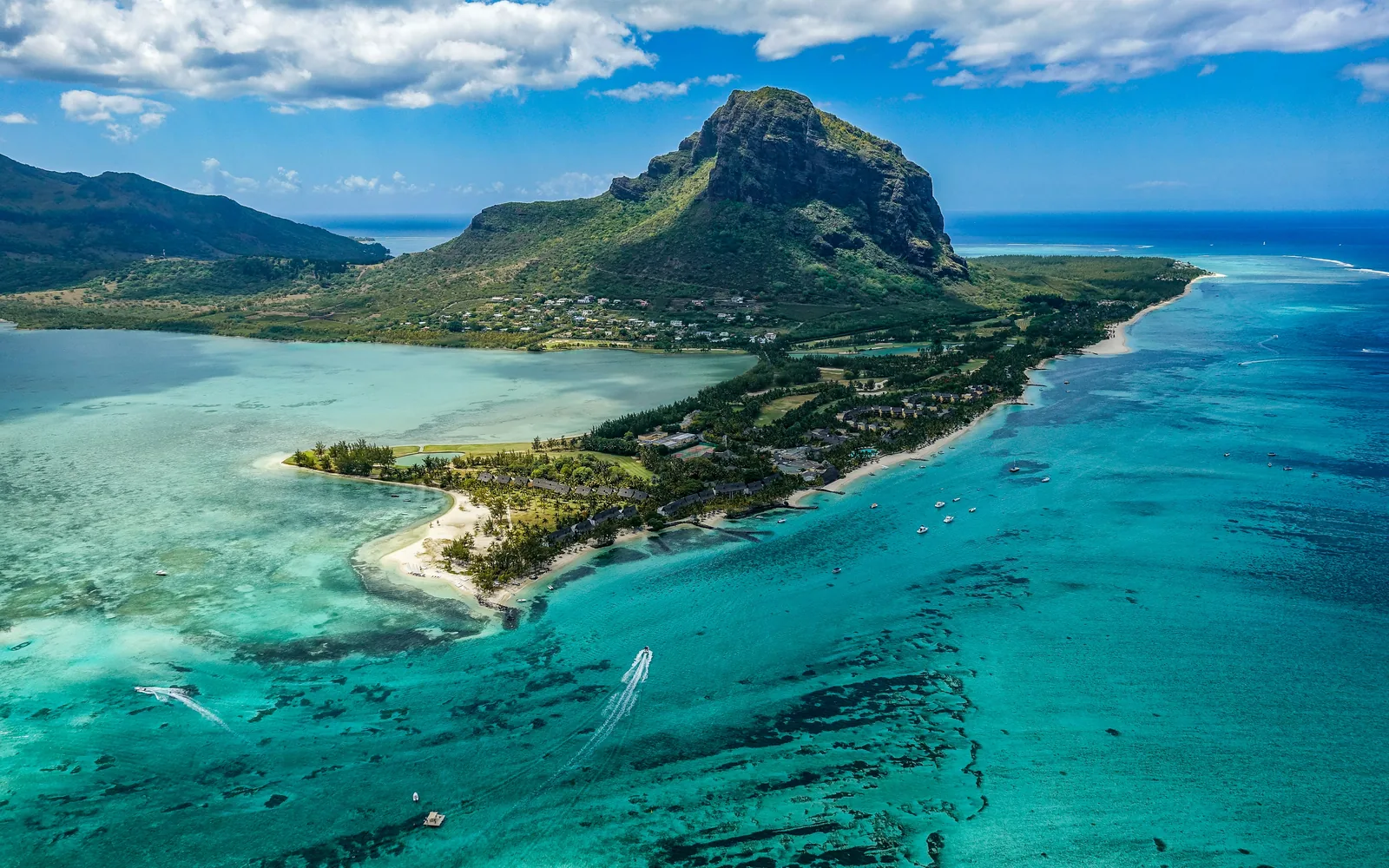
Mauritius is a 2,000 km² volcanic island, 900 km off Madagascar
The island is small enough to drive around in a long day and dense enough that no part of it is more than a 90-minute drive from the airport. That density helps connectivity: cellular networks here cover the populated coast and the central plateau densely, with the only real thinning happening on the higher slopes of the Black River Gorges and the offshore islets. The network isn't the question. The question, as everywhere, is what sits between you and the network.
Roamzy charges $6.96 per gigabyte in Mauritius. That's $0.0068 per megabyte, billed in real time as your phone uses data on Mauritian networks. No subscription. No expiry on the unused balance. No minimum bundle. One per-MB rate across 193 countries — that's the entire pricing mechanism, not a marketing line.
How much will Roamzy actually cost on this trip?
Visitor patterns in Mauritius split into two: the resort week (mostly on hotel Wi-Fi, some maps and messaging on the road) and the island-tour week (more cellular as you cross between coasts). Plan on 0.5–0.8 GB/day on cellular for resort guests and 1 GB/day for self-drive travelers:
| Trip length | Roamzy ($6.96/GB) | Tourist roaming pass | Local SIM at SSR |
|---|---|---|---|
| 5 days (resort) | $17.41 (2.5 GB) | $45–110 | $15–30 + 30-day cap |
| 10 days (mixed) | $52.22 (7.5 GB) | $80–180 | $25–50 + 30-day cap |
| 2 weeks (self-drive) | $97.48 (14 GB) | $150–320 (often two passes) | $35–70 + 30-day cap |
Competitor prices in columns 3 and 4 are 2025 ranges based on typical offerings; exact figures depend on your home carrier and the airport store you visit. Roamzy's rate in column 2 is our actual published rate from the pricing page.
A local SIM at Sir Seewoosagur Ramgoolam International (SSR/MRU) is one of the cheaper options if you're staying long. The trade-off is the standard one: passport, KYC, queue after a long-haul, and a paper card that's bound to expire on a 30-day cap. For a resort week, the math doesn't favor it. For a month, it might — that's a place where being honest about the alternative matters more than pushing the eSIM.
How is coverage distributed by region?
| Region | 4G/5G | Reality |
|---|---|---|
| Port Louis, Quatre Bornes, Curepipe | 5G | Stable across the urban corridor and Caudan waterfront |
| North coast (Grand Baie, Trou aux Biches) | 4G/5G | Strong across the resort strip |
| East coast (Belle Mare, Trou d'Eau Douce) | 4G | Solid in resort areas; weaker on inland sugarcane roads |
| South coast (Le Morne, Bel Ombre) | 4G | Workable; the Black River Gorges climbs reduce signal |
| Central plateau and Chamarel | 4G | Patchy on mountain roads; offline maps useful |
| Île aux Cerfs, Île aux Aigrettes | Partial 4G | Shore signal works; the boat ride drops out briefly |
| Rodrigues (the smaller sister island) | 4G | Near settlements; sparse on the eastern interior |
Mauritius is one of the better-covered Indian Ocean islands; the volcanic interior creates the only meaningful gaps. If you're hiking the Black River Gorges or driving the back roads from Chamarel to Bel Ombre, download offline maps in advance.
What you'll feel about Mauritius specifically
- Self-drive is normal. Most resort guests rent a car at SSR and explore. The eSIM matters here — Google Maps, the occasional toll-app sign, a parking-lot search at Trou aux Biches all eat data on cellular when the resort Wi-Fi is two hours away.
- Resort Wi-Fi is uneven. Larger properties have decent throughput in the lobby and decent rooms; some struggle at the beachfront and at the spa. The eSIM bridges that.
- Card payments work in cities and resorts; cash and bank-card mix in markets. Your bank app's MFA prompt won't work without a connection. The eSIM keeps that loop closed.
- Day-trips to Île aux Cerfs and Île aux Aigrettes involve a boat. Expect signal at the pier on either end, partial in the middle.
How do I install my Roamzy eSIM?
| Plug type | Voltage | Frequency | iOS | Android |
|---|---|---|---|---|
| Type C, G, K | 230 V | 50 Hz | iPhone XS+ | Pixel 3+, Galaxy S20+ |
- Sign in to Roamzy via Telegram or Google
- Your first eSIM is free and comes with real data on us. After that, top up from $20 in stablecoins (USDT or USDC): no cards, no banks, no FX surcharges
- The QR code appears in your dashboard as soon as the eSIM is issued
- On the iPhone itself (iOS 17.4 or newer), tap Tap to install in the QR card; otherwise Settings → Cellular → Add eSIM → scan QR (do this on home Wi-Fi before flying)
- The counter starts the moment you land at SSR
Supported stablecoins, networks, and common iPhone/Android setup errors are in the FAQ.
What are Roamzy's honest limitations?
Three traps Roamzy doesn't have, because they were never built in.
- No welcome promo that flips on the second top-up. Top-up #1 and top-up #20 cost the same per megabyte — $0.0068 either way.
- No fine-print throttling halfway through the resort week. One rate, full speed.
- No auto-renewal you forgot to cancel before flying back from SSR. Balance runs out, the eSIM stops. No background charge to a card you'd already moved on from.
There's no cheaper version of this tariff hiding behind a countdown, because there's no countdown. Mauritius is metered by the megabyte, and that's the whole mechanism, not the pitch.
What if my route extends across the Indian Ocean?
Mauritius pairs naturally with the rest of the region. The same per-MB model applies the moment you land elsewhere, no manual switching:
- Seychelles — common Indian Ocean pairing, frequent direct flights
- Madagascar — short hop west, very different network reality
- If you want the underlying mechanics — how roaming actually gets priced and why it hurts