1.84 million km², a Nile valley, a lot of empty country
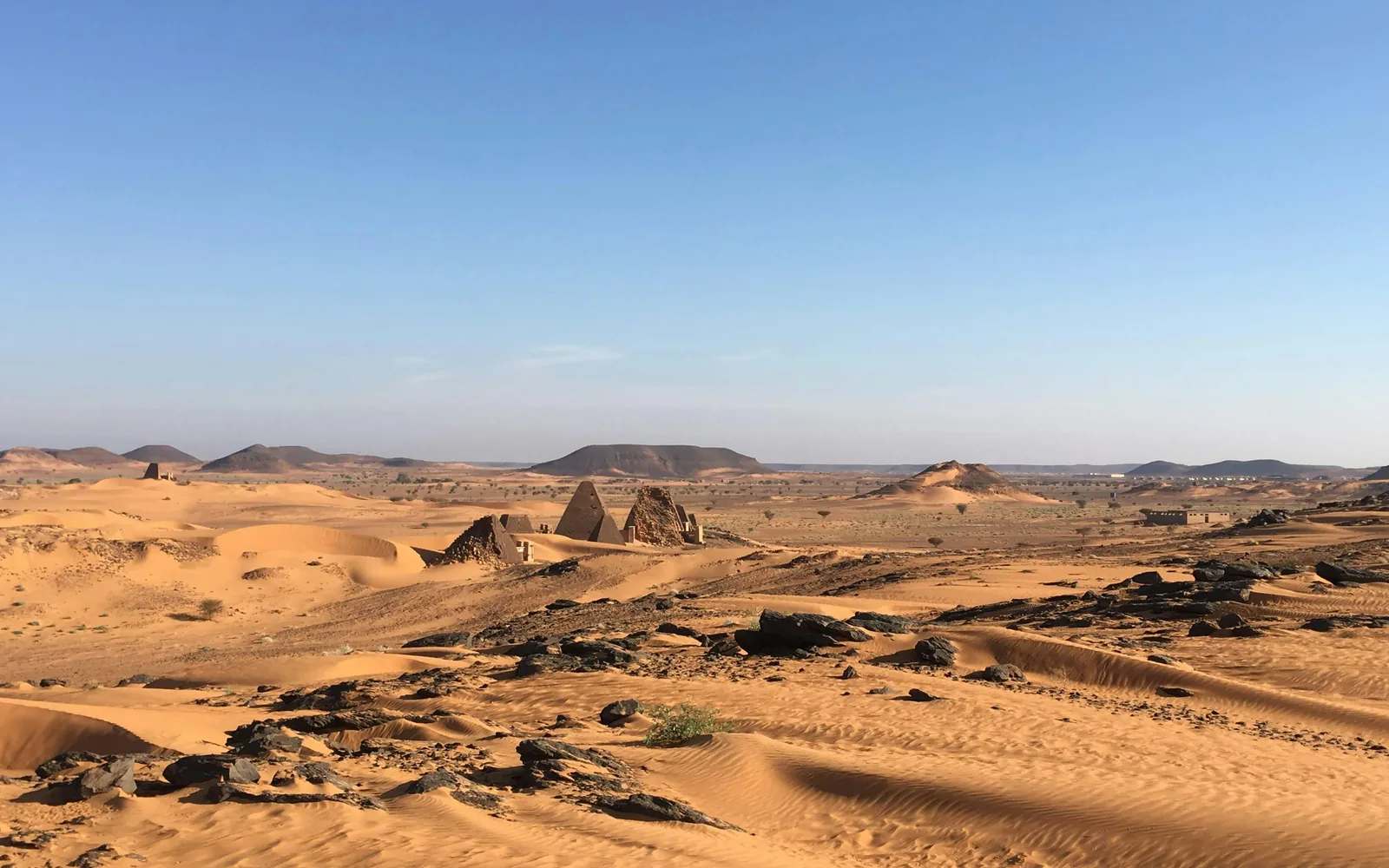
Sudan covers about 1.84 million km² and holds around 50 million people, the bulk of them concentrated along the Nile and its tributaries — Khartoum and Omdurman at the confluence of the Blue and White Niles, then the cities to the north (Atbara, Dongola, Wadi Halfa) and to the east (Port Sudan on the Red Sea, Kassala). The country also contains some of the most archaeologically significant sites in Africa — the Meroe pyramids, the Nubian temples, the Jebel Barkal complex. Foreign visitors today are predominantly diaspora, NGO and aid staff, journalists, the rare expedition tourist heading for the pyramids of Bajrawiya. The cellular network covers the Nile corridor and the major cities workably; the deserts to the east, west, and north are sparse.
Roamzy charges $10.96 per gigabyte in Sudan. That's $0.0107 per megabyte, billed in real time on Sudanese networks. No subscription, no expiry on the unused balance, no minimum bundle. One per-MB rate across 193 countries.
How much will Roamzy actually cost on this trip?
Cellular use is moderate: maps in Khartoum, the WhatsApp to a fixer or driver, the camera-translator on Arabic signs, voice notes home, the rare bank-app push. Office, hotel, and compound Wi-Fi handles the heavier work. Plan on 0.3–0.5 GB/day:
| Trip length | Roamzy ($10.96/GB) | Tourist roaming pass | Local SIM at Khartoum |
|---|---|---|---|
| 3 days (~1.2 GB) | $13.15 | $30–80 | $5–15 + KYC and a passport scan |
| 1 week (~2.8 GB) | $30.68 | $60–140 | $10–25 + paperwork |
| 2 weeks (~5.6 GB) | $61.36 | $120–280 (often two passes) | $15–35 + 30-day cap |
Competitor prices in columns 3 and 4 are 2025 ranges based on typical offerings; many home carriers don't list Sudan in tourist packs at all. Roamzy's rate in column 2 is our actual published rate from the pricing page.
A local SIM at Khartoum airport is sold to foreigners but the registration is paperwork-heavy and current network conditions vary by region. The eSIM is the lighter call.
Where it works and where it doesn't
- Khartoum and Omdurman — 4G across the metropolitan area; signal at the confluence area and on the road in from KRT
- Port Sudan, Kassala, Atbara, Dongola — workable LTE in the regional cities
- The Nile corridor — signal at the populated points along the river, sparse in the long stretches between
- Meroe pyramids (Bajrawiya), Jebel Barkal, the Nubian temples — patchy; signal at the visitor settlements, sparse on the access tracks
- Red Sea coast (Suakin, Sanganeb) — 4G in Port Sudan, weaker out on the dive boats
- Darfur, Kordofan, the deep deserts — assume nothing; satellite communication country
- Conflict-affected periods — service can be temporarily disrupted in specific regions. The eSIM balance survives and reattaches when service returns
Any expedition outside the Nile cities and the major roads needs offline-cached maps and a satellite messenger as baseline kit.
How do I install my Roamzy eSIM?
| Plug type | Voltage | Frequency | iOS | Android |
|---|---|---|---|---|
| Type C, D | 230 V | 50 Hz | iPhone XS+ | Pixel 3+, Galaxy S20+ |
- Sign in to Roamzy via Telegram or Google
- Top up with a minimum of 20 USDT — stablecoins, no cards, no banks, no FX surcharges
- The QR code appears in the dashboard once payment confirms
- Settings → Cellular → Add eSIM → scan QR (on home Wi-Fi before flying)
- The counter starts when you land at Khartoum (KRT) or Port Sudan (PZU)
Stablecoin payment is the practical channel — international cards charging from inside Sudan are unreliable. The dashboard top-up runs on USDT. Setup edge cases are in the FAQ.
What are Roamzy's honest limitations?
- No welcome promo that flips on the second top-up. Top-up #1 and top-up #20 cost the same per megabyte.
- No fine-print throttling. One rate, full speed where there's signal — first GB and the tenth cost $0.0107/MB.
- No auto-renewal. Balance runs out, the eSIM stops.
What if my route continues across the region?
- Egypt — overland north via Wadi Halfa, separate country rate
- South Sudan — overland south, common rotation
- If you want the underlying mechanics — how roaming actually gets priced and why it hurts