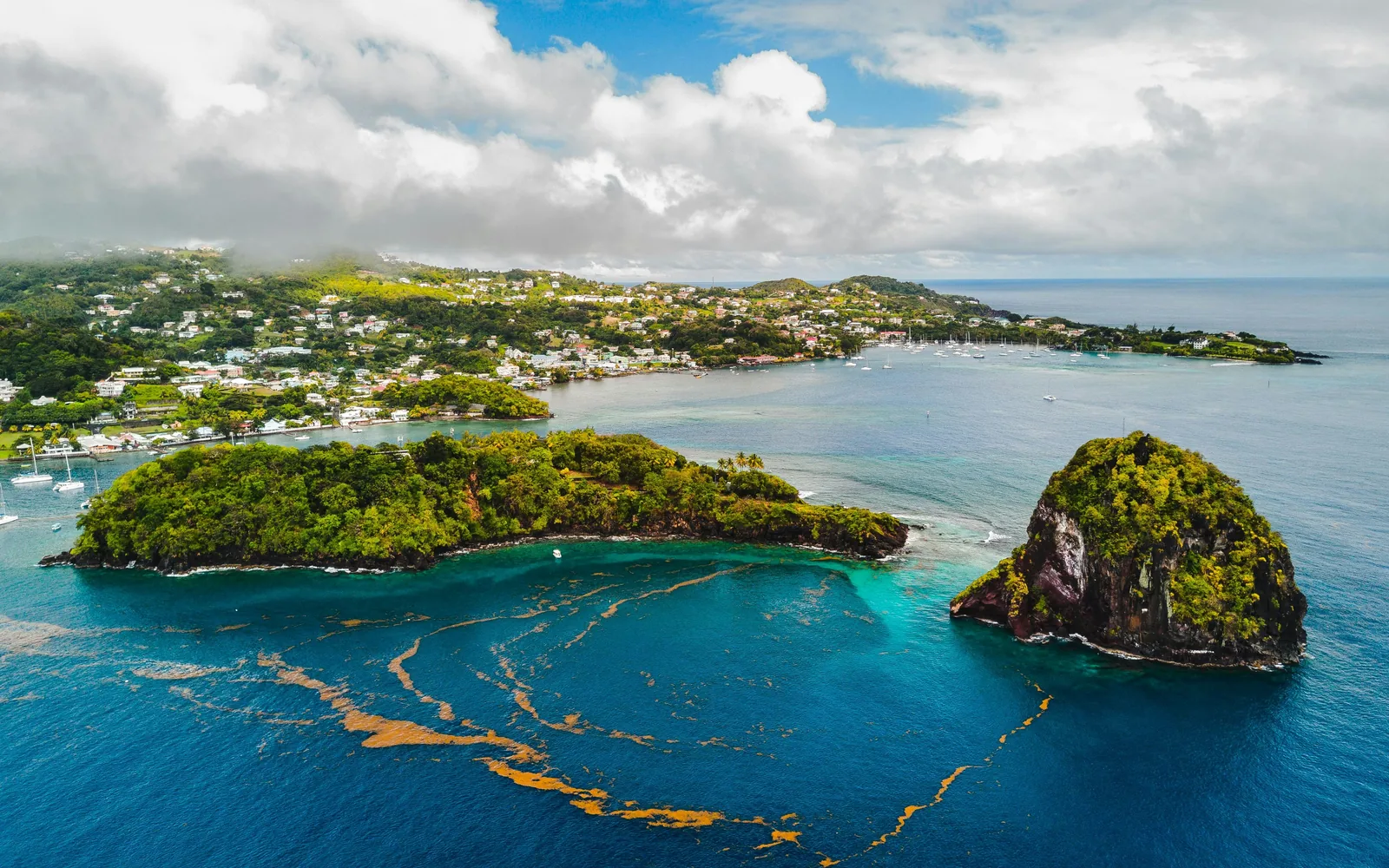
One main island, thirty-two smaller ones, one connectivity model
Saint Vincent and the Grenadines is a yacht-charter destination as much as a resort one. You arrive at SVD on the main island, ferry or fly to Bequia, sail down to Mustique, anchor at the Tobago Cays. Each island has its own coverage shape — some have a 4G tower in the village, some have nothing past the beach — and the underlying tariff has to keep up across all of them without a paper SIM swap each time.
Roamzy charges $7.17 per gigabyte across Saint Vincent and the Grenadines. That's $0.0070 per megabyte, billed in real time. The eSIM stays attached as you island-hop. One per-MB rate across 193 countries means the same model on Bequia as on the main island.
How much will Roamzy actually cost on this trip?
Sailors and resort guests both use less cellular data than they expect — much of the day is sitting on lobby Wi-Fi or anchored in a cove. Plan on 0.4–0.6 GB/day on cellular:
| Trip length | Roamzy ($7.17/GB) | Tourist roaming pass | Cruise-ship Wi-Fi |
|---|---|---|---|
| 1-day cruise stop | $3.50 (500 MB) | — | $25–35 |
| 5 days (resort) | $17.92 (2.5 GB) | $45–110 | — |
| 2 weeks (sailing charter) | $50.18 (7 GB) | $80–180 (often two passes) | — |
Competitor prices in columns 3 and 4 are 2025 ranges based on typical offerings; exact figures depend on your home carrier, your hotel, and your cruise line. Roamzy's rate in column 2 is our actual published rate from the pricing page.
A local SIM at Argyle International runs about $15–30 plus passport and the queue. On a charter that island-hops every day, paying twice for the privilege of switching SIMs doesn't save anything.
Where does Roamzy actually work on the ground?
- Kingstown, Calliaqua, the south coast — solid 4G/LTE
- Bequia (Port Elizabeth and Princess Margaret Beach) — workable 4G in the village; the inland walks weaken
- Mustique — coverage near the airport and around the village; signal thins fast
- Canouan and Union Island — 4G near settlements, patchy elsewhere
- Tobago Cays Marine Park — minimal cellular; expect Wi-Fi off the charter, not from a tower
- Inter-island ferry crossings — partial signal mid-channel
The pattern is consistent across the region: signal lives where people live. Anchorages near villages keep you connected; remote bays don't. Offline maps cover the rest.
How do I install my Roamzy eSIM?
| Plug type | Voltage | Frequency | iOS | Android |
|---|---|---|---|---|
| Type A, B, G, K | 230 V | 50 Hz | iPhone XS+ | Pixel 3+, Galaxy S20+ |
- Sign in to Roamzy via Telegram or Google
- Your first eSIM is free and comes with real data on us. After that, top up from $20 in stablecoins (USDT or USDC): no cards, no banks, no FX surcharges
- The QR code appears in your dashboard as soon as the eSIM is issued
- On the iPhone itself (iOS 17.4 or newer), tap Tap to install in the QR card; otherwise Settings → Cellular → Add eSIM → scan QR (on home Wi-Fi before the charter)
- The counter starts on landing at Argyle International (SVD) or at the cruise pier
Supported stablecoins, networks, and common iPhone/Android setup errors are in the FAQ.
What are Roamzy's honest limitations?
Three traps Roamzy doesn't have, because they were never built in.
- No welcome promo that flips on the second top-up. First top-up and twentieth bill the same per megabyte.
- No fine-print throttling that surfaces on the day you anchor at Tobago Cays.
- No auto-renewal you forgot to cancel after the charter ended. Balance runs out, the eSIM stops.
In Saint Vincent and the Grenadines the rate is the whole story: no bundle mechanics, no validity windows, no surprises staged for later. We engineered the tariff down to that single number and left it there.
If the cruise or charter continues
- Barbados — typical pairing, short flight or ferry north
- Saint Kitts and Nevis — earlier or later port on most itineraries
- If you want the underlying mechanics — how roaming actually gets priced and why it hurts