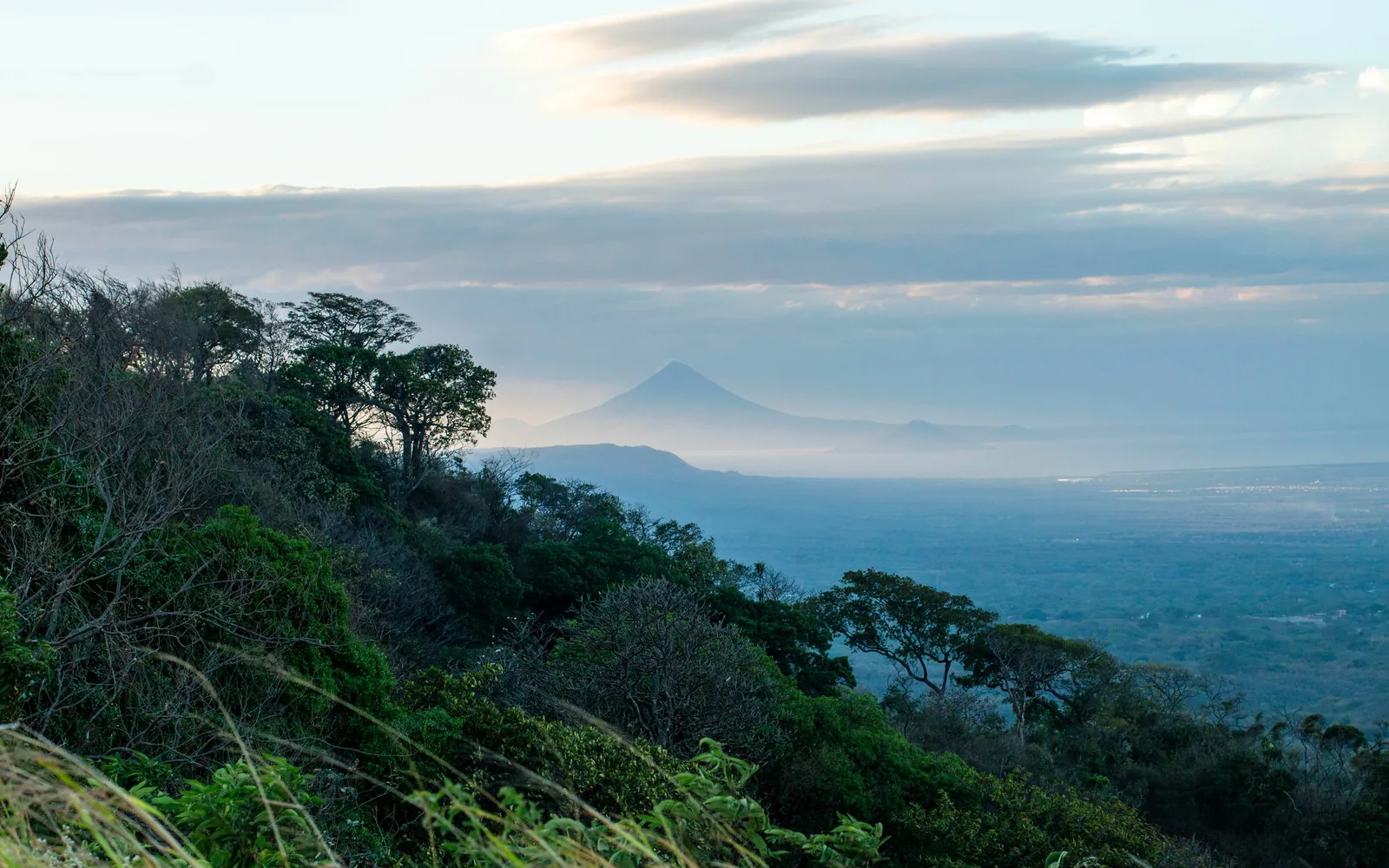
The route stitches three towns and a lake
Most travelers see Granada, San Juan del Sur, and Ometepe in some order, with León thrown in if there's an extra day. The route is a few hundred kilometres total, the shuttles run on time, and the connectivity reality is reasonable on the asphalt and patchier off it. The Caribbean coast — Bluefields, the Corn Islands — is a separate trip and a separate network experience.
Roamzy charges $1.43 per gigabyte in Nicaragua, billed in real time at $0.0014 per megabyte. No subscription, no expiry, no minimum bundle. One per-MB rate across 193 countries is the whole story of the charge, not a marketing line.
How much will Roamzy actually cost on this trip?
A typical visitor uses 0.5–1 GB per day: maps to the hostel in Granada, the ferry schedule for Ometepe, ride-hail in Managua, the camera-translator on Spanish signage, video calls home from a hammock in San Juan. Call it 1 GB/day:
| Trip length | Roamzy ($1.43/GB) | Tourist roaming pass | Local SIM at MGA |
|---|---|---|---|
| 3 days | $4.30 | $15–40 | $5–15 + passport |
| 1 week | $10.04 | $30–80 | $8–20 + 30-day cap |
| 2 weeks | $20.07 | $70–140 (often two passes) | $12–25 + cap |
Competitor prices in columns 3 and 4 are 2025 ranges based on typical offerings; exact figures depend on your home carrier and the airport store you visit. Roamzy's rate in column 2 is our actual published rate from the pricing page.
A SIM at Augusto C. Sandino is sold but takes time and a passport scan after a long day; the eSIM is already attached when you walk out of arrivals.
Where does Roamzy work in this country?
Nicaragua's networks follow population density, which means the Pacific corridor is well served and the Caribbean side isn't:
- Managua, Granada, León, Masaya — 4G/LTE at 95%+, 5G in central Managua
- San Juan del Sur and the southern Pacific surf coast — solid LTE in town, weaker on the longer beach drives toward Maderas and Hermosa
- Ometepe Island — 4G in Moyogalpa and Altagracia, weaker on the volcanic flanks of Concepción and Maderas
- The Pan-American highway from Honduras to Costa Rica — continuous LTE on the asphalt, gaps in the long inter-village stretches
- Estelí and the northern coffee triangle — fine in town, patchier on the back roads to Miraflor and Somoto
- Bluefields, the Corn Islands, the RACS — 3G/4G at the towns, near-zero on the boats and the smaller cays
For Ometepe's volcano hikes, GPS plus offline maps. The signal at the summit isn't worth depending on.
How do I install my Roamzy eSIM?
| Plug type | Voltage | Frequency | iOS | Android |
|---|---|---|---|---|
| Type A, B | 120 V | 60 Hz | iPhone XS+ | Pixel 3+, Galaxy S20+ |
- Sign in to Roamzy via Telegram or Google
- Top up the eSIM with a minimum of 20 USDT — stablecoins, no cards, no banks, no FX surcharges
- The QR code appears in the dashboard once payment confirms
- Settings → Cellular → Add eSIM → scan QR
- The counter starts the moment you land at MGA
Supported stablecoins, networks, and common iPhone/Android setup errors are in the FAQ.
What are Roamzy's honest limitations?
Three traps Roamzy doesn't have because they were never built in. No welcome promo that flips on the second top-up. No fine-print throttling. No auto-renewal you forgot to cancel and discover six months later on a card you don't watch.
Nicaragua costs what the meter says and stops costing the moment you do. That's the entire product; making it sound cheaper would require inventing print we deliberately don't have.
What if my trip continues to other countries?
Nicaragua sits on the gringo trail, and most travelers continue north or south:
- Costa Rica — Peñas Blancas to La Cruz in a shuttle; the eSIM grabs the Costa Rican network at the border
- Honduras — north through Las Manos toward Tegucigalpa
- If you want the underlying mechanics — how roaming actually gets priced and why it hurts