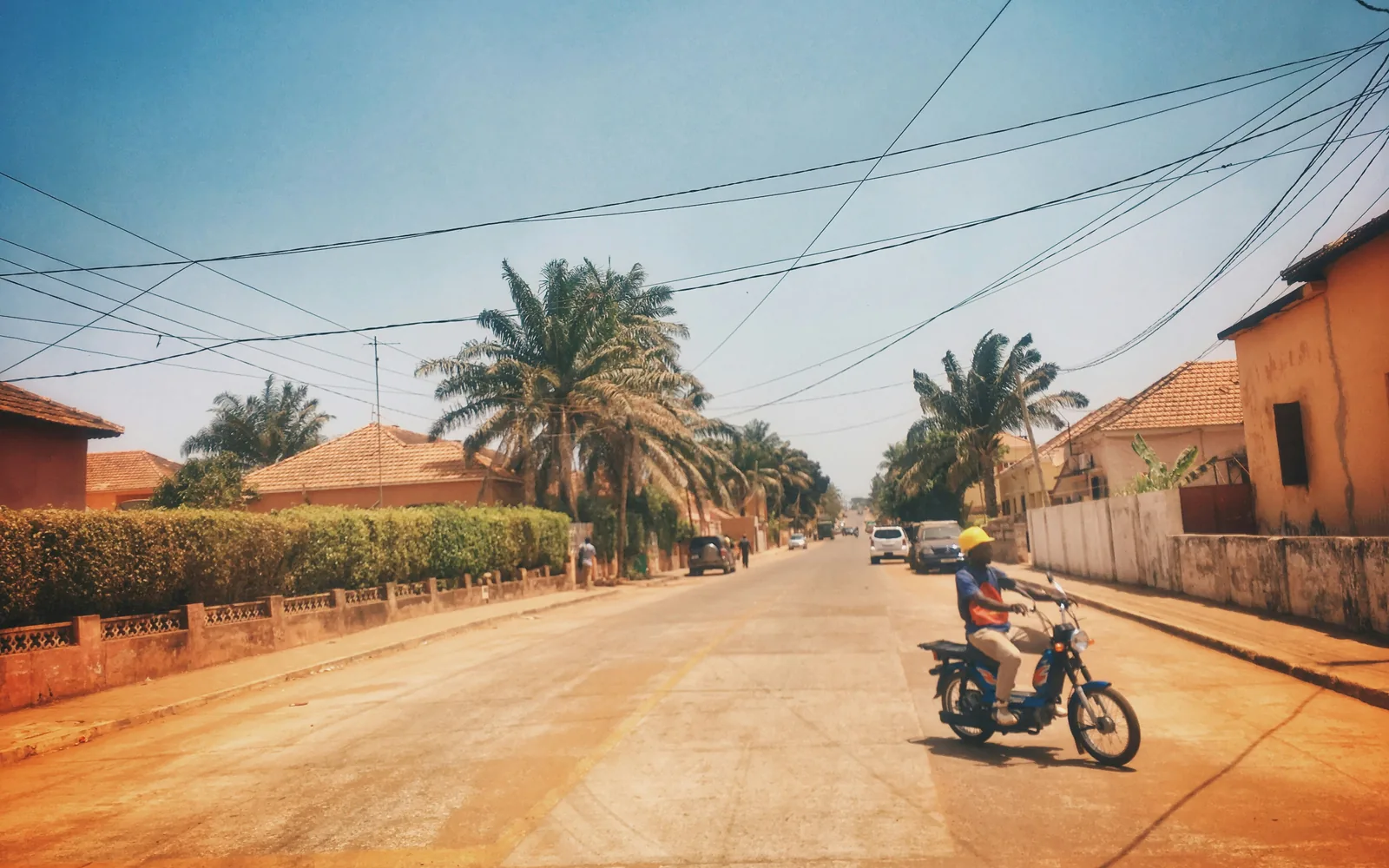
A 36,000 km² country, two visitor patterns
Guinea-Bissau covers about 36,000 km² with a population of roughly 2 million, the bulk of it concentrated in Bissau, the regional capitals (Bafatá, Gabú), and the coastal strip. The country is one of the few Lusophone-African destinations on the West African mainland, and the visitor map has two clear shapes: a working-and-business pattern in Bissau and the inland market towns, and a leisure pattern out to the Bijagós Archipelago — a UNESCO biosphere of dozens of islands famous for sport fishing and saltwater hippos. The cellular network covers the populated mainland workably and thins out fast on the islands.
Roamzy charges $3.69 per gigabyte in Guinea-Bissau. That's $0.0036 per megabyte, billed in real time on Bissau-Guinean networks. No subscription, no expiry on the unused balance, no minimum bundle. One per-MB rate across 193 countries — the figure on the invoice, not a marketing line.
How much will Roamzy actually cost on this trip?
Cellular use is moderate: maps in Bissau, the WhatsApp to a guide or boat captain, the camera-translator on a Portuguese menu, voice notes home, the rare bank-app push. Most of the heavy lifting happens on hotel and lodge Wi-Fi. Plan on 0.3–0.5 GB/day:
| Trip length | Roamzy ($3.69/GB) | Tourist roaming pass | Local SIM at Bissau |
|---|---|---|---|
| 3 days (~1.2 GB) | $4.42 | $25–55 | $5–15 + KYC and a passport scan |
| 1 week (~3 GB) | $11.06 | $45–90 | $8–20 + paperwork |
| 2 weeks (~6 GB) | $22.12 | $80–180 (often two passes) | $15–35 + 30-day cap |
Competitor prices in columns 3 and 4 are 2025 ranges based on typical offerings; exact figures depend on your home carrier and the airport store you visit. Roamzy's rate in column 2 is our actual published rate from the pricing page.
A local SIM at Bissau-Osvaldo Vieira (OXB) is workable for a long stay. For a one-week trip — particularly one heading out to the Bijagós — the eSIM saves the morning.
Where does Roamzy work in this country?
- Bissau (Bairro de Belém, the port area) — 4G across the city; signal along the Geba estuary and on the airport road
- Bafatá, Gabú, Cacheu — workable LTE in the regional towns and along the connecting roads
- The Bijagós Archipelago — patchy. Signal on Bubaque (the main town) and at fishing-lodge clusters, sparse on the smaller islands and out at sea. Lodge Wi-Fi covers most of the gaps
- Cantanhez and Cufada protected areas — 3G at lodges and entry; nothing in the wildlife zones
- Border zones — the last few kilometers before Senegal or Guinea sometimes pull toward neighboring networks
How do I install my Roamzy eSIM?
| Plug type | Voltage | Frequency | iOS | Android |
|---|---|---|---|---|
| Type C | 220 V | 50 Hz | iPhone XS+ | Pixel 3+, Galaxy S20+ |
- Sign in to Roamzy via Telegram or Google
- Your first eSIM is free and comes with real data on us. After that, top up from $20 in stablecoins (USDT or USDC): no cards, no banks, no FX surcharges
- The QR code appears in your dashboard as soon as the eSIM is issued
- On the iPhone itself (iOS 17.4 or newer), tap Tap to install in the QR card; otherwise Settings → Cellular → Add eSIM → scan QR (on home Wi-Fi before flying)
- The counter starts when you land at Bissau (OXB)
Supported stablecoins and common setup errors are in the FAQ. The dashboard handles top-ups in USDT.
What are Roamzy's honest limitations?
- No welcome promo that flips on the second top-up. Top-up #1 and top-up #20 cost the same per megabyte.
- No fine-print throttling. One rate, full speed where there's signal — first GB and the tenth cost $0.0036/MB.
- No auto-renewal. Balance runs out, the eSIM stops.
What if my route continues across West Africa?
- Senegal — north overland, common rotation
- Guinea — southeast, separate country rate
- If you want the underlying mechanics — how roaming actually gets priced and why it hurts